
My Boyhood Memories.
The following are some excerpts from a book I am writing for my daughter Katie. After reading The Necessity of a Place, 25 years at the Water’s edge which was about our time at our cottage in N. Michigan she asked I write about growing up in the 50’s and 60’s. The setting is a small town, Breedsville, Mi. It was and is central to my life. As with any memoir, reaching back 70 years results in a hazy memory. I have done my best to recall the people and events, but I am certain there are errors and misremembering. But its my life. So its my story. I am sharing this at the request of a few old friends I grew up with. I hope it brings back fond memories like it has for me.
’m happy you’re here reading my story! Please note that all content on this blog is copyrighted. The stories shared on this blog are written from my personal perspective. Memory is a living thing—it fades, it sharpens, and it filters through our emotions. While I have made every effort to ensure the integrity of these accounts, they are ultimately my own “emotional truth.” These excerpts are for personal reading only and may not be distributed, reposted, or used elsewhere without my express permission. Sharing a link back to this post, however, is appreciated.
Growing Up All Over Again; My Boyhood Memories
Preface
My daughter Katie asked me a simple question. “Dad, what was it like for you growing up?”
It stopped me. I realized she had no idea. Neither did my wife Barb. I had never told them. I’m not a storyteller around the dinner table. Never have been. If this story was going to get told, it had to be written down.
So I wrote it down.
I grew up in Breedsville, Michigan. A small town on the Black River in the fruit belt of southwestern Michigan. Ten miles east of Lake Michigan. Maybe a hundred people. Four corners, a millpond, and a river running through it. In my mind it was Mayberry and Tom Sawyer’s Hannibal rolled into one — only smaller.
The time was the mid-1950s through the mid-1960s. Tom Brokaw called our parents the Greatest Generation. They earned it. They fought a world war, came home, and built something. Families. Communities. A country. We were their children. The Boomers. We inherited a world that was simpler, harder, and more connected than anything Katie’s generation has known.
It was an amazing time to be a boy. It will never come again.
When I wrote The Necessity of a Place I came to understand something I hadn’t seen clearly before. The lake community on Little Bass Lake was largely my generation — or close to it. Same values. Same reference points. Same post-war American childhood. Without realizing it, I had found my way back to something I had lost when I left Breedsville. The community I grew up in. That’s what the cottage was really giving me all those years.
Katie read that book and asked for more. She wanted to know where that boy came from. This is the answer.
This is where I came from
Prologue: I Am a Lucky One
I have just turned 74. I am coming to grips with my mortality. I see childhood friends and contemporaries passing. I know how this ends.
But I recently read something that reframed it for me. It was in a book on Secular Buddhism. A quote from Richard Dawkins — a man I agree with on almost nothing. It was in a chapter titled “Life Before Death”. But he wrote something that stopped me cold. The idea was this: the odds against any of us being born at all are so staggering they dwarf comprehension. The people who were never born outnumber the living by a margin that makes the sand grains of Arabia look small. Poets greater than Keats. Scientists greater than Newton. Never born. Never given the chance.
But I was. You were. That makes us the lucky ones.
I am a lucky one.
Even as I look at the dwindling days I have left here, I am reminded of this. Writing this memoir about my childhood experiences reinforces it. I have had an amazing life for a little boy from Breedsville, Michigan. I am thankful!
Dad was not present when I arrived. He was deployed in Korea during the late stages of the war. On December 1, 1951, I was born to twenty-year-old Lorraine Tomczak Dentzman. It was Dad’s birthday the day before. He had just turned twenty-five. I was a late birthday present he wouldn’t unwrap for months.
Mom was the daughter of Polish immigrant children — Walter Tomczak and Lillian Kielbowitz — who had migrated to southwestern Michigan from East Chicago, Indiana. They had opened a small grocery store in Breedsville. Walt’s Grocery. In the years to come it would be my second home and my safe haven.
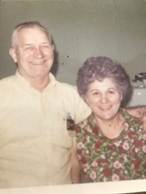
Mom had attended Michigan State for one year after high school. She loved it. She had aspirations. Excitement. A future she could feel. After that first year her parents told her they couldn’t afford another. She kept her MSU suitcase the rest of her life. A reminder of what might have been.
A nineteen-year-old girl living with her parents in the 1950s had few choices. Find menial work or get married. She met Bob Dentzman — twenty-four years old, a Marquette graduate from Bangor, five miles away. He came from a respectable Catholic family. His father Bill was the Bangor postmaster. Dad was handsome and rugged and fun-loving. He had attended Marquette on a boxing scholarship. Mom believed he had potential. A college man was a catch. Little did she know what the future held.
Dad was drafted and bound for Korea. He pleaded with Mom to marry him before he shipped out. She relented. On December 26, 1950 they were married. Mom in her wedding dress. Dad in his military dress greens. A beautiful couple on a cold winter day.
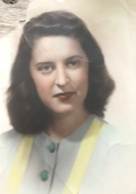
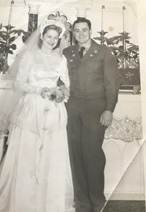
Mom’s Senior H.S. Picture Their Wedding Day 12/26/1950
After a short honeymoon Dad left for basic training and then Korea. He returned a changed man.
Mom and I went home to the store. After a short hospital stay we moved into the back quarters of Walt’s Grocery — maybe eight hundred square feet shared with Grandma and Grandpa, my Aunt Di, and Great Grandfather Matthew, Grandpa’s father. Matthew gifted me one hundred dollars at my birth. In 1951 that was a serious sum. I have always figured it was his way of welcoming me into a world he wouldn’t be in much longer.
They made the space work. Fold-out couch. Day beds. Mom with her colicky baby boy making it interesting at night. We stayed until Dad came home from Korea in mid-1952.
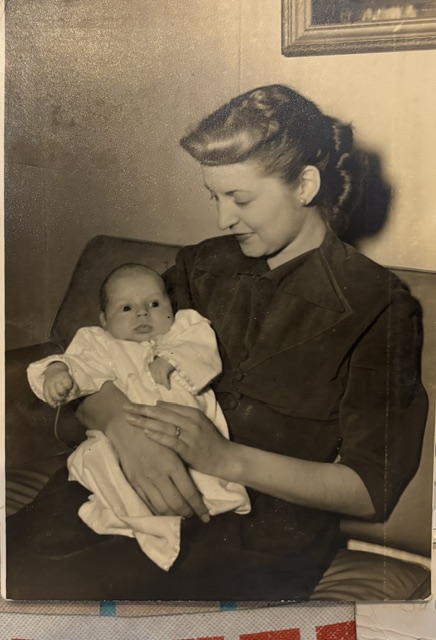
Me and Mom at Grandpa and Grandma’s
When Dad returned the young family needed its own place. The solution was his childhood home on Munson Lake — a small lake six miles north of Breedsville. During the Depression my great-grandfather Ben Schaflein had bought a farm there. Dad and his five siblings — Billy, Ruth, Em, Mary, and Dick — had grown up on that farm with their parents and old Ben during the hard years.
Dad told me stories about Munson Lake throughout my childhood. Years later my Aunt Mary captured many of them in her own memoir. That book was the spark for The Necessity of a Place. And for this one.
But Munson Lake didn’t work for us. Not then. The driveway was three-quarters of a mile from the main road, winding through an apple orchard and a small woods. Today that sounds like paradise. For a young mother alone with a toddler while her husband worked, it was something else. The isolation wore on Mom. It wasn’t sustainable.
The farm was sold years later to a prominent doctor from Chicago. He was gay, at a time when that wasn’t readily accepted. The isolation was exactly what he needed. More on him later.
Grandma Tomczak came to the rescue. She usually did.
She found a house on East Main in Breedsville, about a quarter mile from the four corners where Walt’s Grocery stood. It had belonged to Jim Seliga, the local barber. Jim’s wife had died some years earlier and Grandma had taken him under her wing — bringing food, checking in, doing what people did for each other in those days. When Jim passed, Grandma bought his house for my parents.
It wasn’t much. An old house that needed work. We had remodel projects for well over ten years. But it was ours. It was the home I grew up in. My brother John lives there to this day.
It
was where my boyhood memories were made.
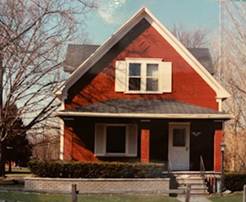
My old home after 30 years of remodeling. My brother John still lives there today.
Breedsville, RFD
I should explain the heading. RFD are my initials. But Breedsville had a lot in common with Mayberry from the Andy Griffith Show. Only smaller. Much smaller.
I recently spent some time on the phone with my Aunt Di — my Mom’s sister, eighty-eight years old and sharp as ever. She is the last living link to the Tomczak family story. We talked about the town we both remembered. She confirmed what I already knew. My memory was accurate.
It was a village with genuine small-town charm. Tucked several miles off the main road — M-43 — along the Black River, which wound its way west through several small towns before emptying into Lake Michigan. Safe. Secluded. A four-corners town that the wider world mostly left alone. About two hundred residents, a number that had remained remarkably constant since its founding.
The town was named after Silas Breed, a businessman who built a sawmill on the Black River and helped launch its early prosperity. He was among twenty-five settlers who arrived from New York in 1835, recruited by two men who had scouted the area and liked what they saw. The post office came in 1837. The town incorporated in 1883. During its heyday it had a dance hall, a hotel, a restaurant, a hardware store, a barber shop, and a tavern. Mom told me they used to show movies in the vacant lot next to the tavern on summer nights.
The lumber business eventually died out. But the town survived and reinvented itself. By the time I grew up there it was a quiet bedroom community rooted in agriculture. Fruit farms surrounded us on all sides — blueberries, apples, cherries, peaches. Grain farmers too. When I lived there we had two grocery stores, a post office, two gas stations, the hardware store, and the Breedsville school. Every one of them thrived in its own way.
The millpond was the focal point. People came to fish — pan fish, pike, bass, catfish, bullheads. It wasn’t a great fishing spot by any serious measure. But it was ours.
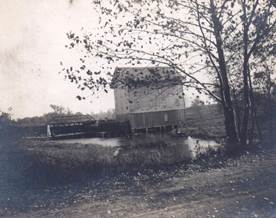
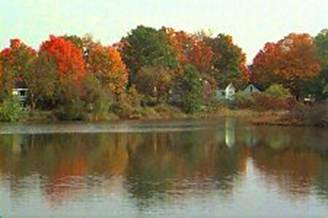
Silas Breed’s saw mill The Mill Pond
Blueberry season brought the migrant workers. Families from Arkansas, Mississippi, Alabama — poor white folks who followed the harvests and scratched out a living doing it. It was family work. Children five years old and up were in the berry patch alongside their parents. They came every summer and they were part of the fabric of the place whether the town fully recognized it or not.
Grandpa’s competitor was Wade Hampton. His slogan was “Trade with Wade” and he was smart about it. He bought a facility west of town — rows of cabins, something like today’s man camp — and cornered the migrant market. The families who stayed there traded with Wade.
Grandpa worked a different angle. Our area had dozens of small lakes and the cottages that came with them. Weekenders from Chicago and northern Indiana who wanted their city comforts in the countryside. Grandpa stocked the Chicago Tribune and the Daily News. He carried what the lake people needed. He also served the Black families who had settled on small farms and homes a few miles out — people who had left Chicago and Gary for the simpler, safer, more affordable life that rural Michigan offered.
Grandpa and Wade were competitors who respected each other. There was an interesting wrinkle to it. Wade had a grandson named Ricky. John and I would go over to Wade’s store to pick out candy or soda that Grandpa didn’t carry. Ricky would come over to Walt’s for the same reason. It was a little strange walking into a competitor’s store. But Wade and his wife Hazel were always good to us.
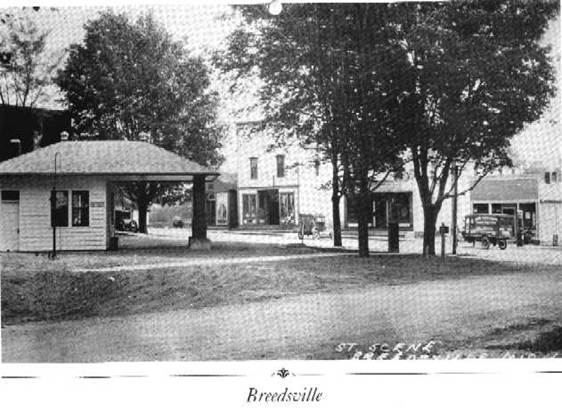
Old Breedsville. The store Grandpa bought has the truck in front of it. The Post Office was next door, then the Tavern. The filling station which became Bill’s Service is at the left.
That was Breedsville. Small, self-contained, and in its own quiet way, complete.
In the pages ahead I’ll take you deeper — the people, the characters, and what it was like to grow up inside all of it.
The Tomczaks
My Grandma and Grandpa Tomczak are not people to be described. They are people to be experienced. And experience them I did. They were my surrogate parents. Walt’s Grocery was my second home. For a brief period after collage, it was my only home. But that’s a story for later.
What my time with them taught me could fill its own book. Kindness. Generosity. Humor. Self-esteem. Hard work. How to treat people regardless of the color of their skin or the circumstances of their life. I didn’t learn these things from lectures. I learned them by watching.
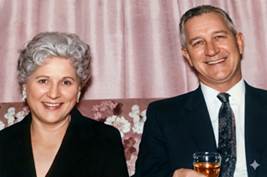
My young grandparents
Grandpa Walt had migrated from the Hammond, Indiana area in the early 1940s. He was a big strapping man — six-foot-one, over two hundred pounds. He was outgoing, jovial, and fun loving. He had married Lillian Kielbowitz, a seventeen-year-old Polish girl, one of the four Kielbowitz sisters. Nell, Vange, and Florence were the others. She was the third youngest. I got my height and build from Grandpa. I grew to six-three. Mom was five-six. Dad five-nine.
Before Michigan they lived in East Chicago, Indiana. Grandpa worked in the steel mill like so many Polish migrants of that era. Eventually the family followed Grandma’s mother, who had remarried a man named Kuzemka and moved to a farm in rural Michigan. Grandma and the girls settled there while Grandpa commuted from Indiana on weekends. The plan was to eventually relocate the whole family.
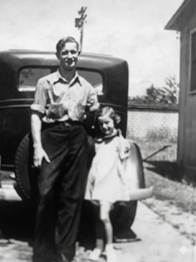
Gramps and Mom at the Kuzemka farm
It was during those farm years that Mom nearly died. Walking a country road with her cousin Elaine, she was struck by a truck. Fractured skull. Punctured eardrum. She was rushed to the hospital in serious condition. The story goes that Grandpa was home that weekend but had too much to drink and couldn’t drive her. Someone else got her there. She survived. Afterwards, Grandpa dialed back his drinking. In all the year’s I was around him I never saw Grandpa drink more than a beer or two. Occasionally, after closing the store and tallying the day’s receipts he and grandma might ave a 6 oz glass of beer. Of course they did, they were Polish.
With the family putting down roots in Michigan, Grandma turned her attention to building something permanent. She was an entrepreneur at heart. She considered a restaurant. In the end they settled on a grocery store.
There was a couple a few miles from the farm — Al and Emily Kovac, Czechs. Poles and Czechs shared similar languages and cultural ties and generally got along well. The Kovacs took my grandparents under their wing, helped them find a location, and taught them the business. The location turned out to be in Breedsville. Walt’s Grocery was born. The family ran it for nearly fifty years.
From the beginning the store’s back quarters were more than a home. They were a refuge for whoever needed one.
When Grandma’s sister Nell went through hard times and took up with another man, her teenage kids Richard and Elaine came to stay. That little eight-hundred square foot space now held six people — four of them teenagers, one bathroom, a couple of beds, and a sofa. I cannot imagine how they managed. But they did.
Richard and Elaine eventually returned to Indiana and their mother. Then came Great Grandpa Matthew — Grandpa’s father. He had been living with Grandpa’s brother Roman but was asked to leave because of his drinking. Grandpa took him in, managed his intake, and gave him a place to land.
Matthew was an interesting man. Grandma told me he had served in the Russian Army and worked as a kind of paramedic — treating sprains, setting broken limbs, providing basic medical care in the field. Back in those days doctor visits were rare and expensive. People came to Matthew for help instead. Grandma watched him closely. She was intrigued. Over the years she applied what she had observed, along with what she read in health magazines, to help her own ailing customers at the store. The healer’s knowledge passed quietly from one generation to the next.
Matthew eventually moved back to Roman’s. I suspect it was around the time Mom and I arrived and the space was needed. Then Dad came home from Korea and we moved out to Munson Lake. Grandma and Grandpa finally had the place to themselves.
For a while anyway. They would take in one more stray eventually. Me. But that comes later.
These were my grandparents. People who accepted inconvenience without complaint and opened their door to whoever needed it. They never asked for anything in return. That’s not something you forget. It’s something you either carry forward or you don’t.
I’ve tried to carry it forward.
Here us my second entry. I probably have horribly misspelled names but I was doing this phoeniticly.
Old People and Young Boys
Some of my earliest shadow memories involve elderly people I visited around town. They had time and were lonely. I had time and was curious. It was a natural arrangement. Nobody planned it. It just happened.
Mrs. Ludaking
Mrs. Ludaking was a widow who lived in a small gray house two doors west of Grandpa’s store. How our friendship started I can’t say. But it did.
She is a shadow to me now — a small woman in a long working dress. What I remember clearly is her garden. It ran behind her modest house along the river. Iris, tiger lilies, phlox, hollyhocks — all tall perennials, chest high or better to a small boy. Perfect for viewing. The fragrance of the iris and phlox I can still remember today.
We had a routine. We would walk the rows together, deadheading spent blooms, cutting a few for a vase inside. Then we would go in and Death Valley Days would be coming on the television. She would fix me a cup of Ovaltine. We would watch together — the program hosted by Ronald Reagan, sponsored by 20 Mule Team Borax.
One afternoon she surprised me. You could send away for a toy 20 mule team complete with covered wagons. She had ordered one for me. I was thrilled. She was too, watching my reaction.
I can’t remember when or why our visits ended. That is the curse of the shadow memory. Perhaps she moved away when she could no longer manage on her own. Perhaps she passed. I never knew.
What I have kept is the garden. The fragrance of phlox on a summer afternoon. An old woman and a small boy walking the rows together.
Mrs. Siebal
A few doors down from the store, across from Mrs. Ludaking, lived Mrs. Siebal — or at least that is the name I recall. A larger woman with white hair, living alone. Her home was on a small rise.
I had decided to earn money walking dogs. Mrs. Siebal came into the store and said she had one I could walk. His name was Sputnik. A black cocker spaniel named after the Russian satellite. Twenty-five cents a walk.
But it was never really about the money for either of us. After the walk I would come inside and Mrs. Siebal would tell me stories. I don’t remember a single one. What I remember is that she had one of the early televisions — a small boxy thing that fascinated me completely.
Eventually my visits stopped. When and why I couldn’t say. But I remember her fondly, and Sputnik with her.
Maimie Van Patten
Maimie is the shadowiest of my shadow memories. He was an old man — truly old, somewhere in his nineties — who lived next door in a run-down two-story house. Dad told me Maimie had memories of the Civil War and the Reconstruction period that followed. At ninety-plus years old in 1955 that was at least mathematically possible.
I remember going into the old house hoping to find a musket or some artifact from the war. There was nothing like that. What there was: a hand pump in the kitchen sink, another outside, and an outhouse in the back. No running water.
What I remember most is the outdoor pump. One winter I did what small boys apparently cannot stop themselves from doing. I licked the handle. My tongue stuck fast. Someone brought water to free it.
I witnessed the same thing happen to other kids over the years. A flag pole works just as well. The lesson never seems to travel far.
Ernie Boudish
Ernie lived in a small place at the back end of our property. A large bald man. Quiet. A bachelor living out his years.
I would visit from time to time to keep him company. What we talked about I have no idea. What does a five-year-old and an old pensioner find to discuss? Something, apparently. He seemed content to have an audience and I was curious enough to listen.
Between our property and his ran a drainage ditch. In the spring it filled with runoff from the fields, carrying water down to the storm drain and into the river. I would fish it with a stick and a piece of string, leaves for quarry.
Along the bank grew wild dewberries. Low to the ground, dark, fat as a man’s thumb. Mom called them dewberries. I called them a reason to linger. I ate my share over the years.
Clarence “Unc” DeForest
Unc DeForest lived in a small side room attached to a house a few blocks from ours. Three hundred square feet at most. A subsistence existence.
I passed his place every day on my walk to Grandpa’s store. In summer his screen door stood open to catch any breeze. I would peek in and shout hello. He was a large, slow-moving man, usually in bib overalls. His speech was garbled but I could understand him most of the time.
Looking back I wonder what filled his days. The paper, maybe. The radio. Mostly I think he was in heaven’s waiting room — biding his time with no friends, no relatives, and nothing much left to wait for except the end. Only a small boy stopping by to say hello.
I never learned his story. But he figures in a couple of mine.
Next to the sidewalk in front of his house stood a hickory tree. Every fall it dropped its nuts. I would gather them up, take them home, crack them open, and eat the meat. My brother tells me that tree is still standing seventy years later. It has outlasted nearly everything else I knew in that town.
My other memory involves earthworms and yellow jackets. I was looking for worms to fish with. Unc took me around back to his shed and muttered: dig there. I dug. I found no worms. What I found was a yellow jacket nest, and the occupants were not pleased about it. They stung me repeatedly and chased me three solid blocks home. If there had been a pond I would have dived in just like in the cartoons.
Eventually I would pass Unc’s place and notice he was gone. His wait was over.
Clint Parker
Clint lived next door to the east, separated from our house by a vacant lot. His place was small — maybe a thousand square feet, three little bedrooms. I was never inside it as a boy. I would get to know it well enough later.
Clint was a gardener. The west side of his house was thick with lilac bushes and climbing roses gone wild. We had lilacs on our side facing his. The vacant lot between us he treated as his own green space, planting sunflowers, perennials, barberry bushes — whatever struck him. I would join him sometimes to help tend it. Truth is it was mostly wildflowers and didn’t need much tending. But it gave Clint something to do with his days and me a reason to be outdoors.
Behind his house stood a long low shed, maybe ten by twenty-five feet. Inside he had a wood stove at the far end with a narrow walkway leading to it, firewood stacked on both sides. A small workbench sat near the stove. In winter he could putter around back there, warm and unhurried. There is no heat in the world like a wood fire in a small shed on a cold day.
In winter we would go out there together. He would start a fire and we would crack black walnuts. I contributed the hickory nuts I gathered at Unc’s. A feral cat lived in the shed — mouse police, same as Midnight at Grandma’s. One winter she had a litter of kittens in the woodpile. They would creep out and eye me with suspicion. When I reached for one I was rewarded with claws and a fast retreat back into the wood. They were not interested in making friends.
Clint surprised me one afternoon. He knew I liked slingshots and anything I could shoot at the wildlife around town. He invited me into the shed and presented me with a bow and arrows he had made himself. He had put real effort into it. The problem was the bow wouldn’t flex, and instead of a bowstring he had used a piece of wire. It would never shoot an arrow.
I didn’t have the heart to tell him. I thanked him as genuinely as I could manage. That bow never fired a shot.
I mentioned I came to know Clint’s house well. That’s because years later I lived in it.
After I graduated from Kalamazoo College and worked four years at a bank I decided to get my MBA at Western Michigan University in Kalamazoo. I had no income and needed a place to stay. My parents had bought Clint’s house after he passed and were renting it out. I moved in with a friend and stayed until I finished graduate school.
It was not without its challenges. At night you could hear the mice in the walls. Barb visited during those years — we had met around that time and would marry shortly after I got my degree. Clint’s old house gave her pause. But they say love is blind. In this case it obscured her vision just enough.
One of my parents’ more practical decisions came later. They donated the house to the local fire department for a practice burn. A cheap way to be rid of it. I understand the logic. But the house where Clint cracked walnuts by a wood stove, where feral kittens hid in the firewood, where I spent my broke graduate school years listening to mice in the walls — it lives now only in memory.
Some things are like that.
The little boy that visited all the old folks.
Town Folk
Breedsville had a stable population for most of its history. From the lumber days through the transition to fruit and grain farming it hovered around two hundred people. Families stayed. Generations followed generations. Everybody knew everybody — including their good points, their bad points, and a few things they probably wished stayed private. Hard to keep secrets in a small town.
I got to know most of the town folk through two channels. My boyhood wandering took me to their doorsteps. Walt’s Grocery brought the rest of them to me. For Grandma and Grandpa the store and its customers were the foundation of their social life. It fit their nature perfectly. I learned how to talk to people by watching them do it.
The businesses were few but sufficient. Two grocery stores, two gas stations, a hardware store, a tavern, and a post office. I walked past or into all of them nearly every day. That is small town life. You know the owners. They know you. There are no strangers.
Green’s Service Station
Directly across the street from Walt’s sat one of the two gas stations, owned by Bill Green. His father Ralph helped out. In those days they were called service stations for good reason. You pulled in and a man came out to fill your tank, check your oil, clean your windshield, and check the air in your tires. Young men who were motor heads gravitated to the stations naturally. It was the place to be if you liked cars.
Bill also did mechanic work. I would stop in regularly to fill my bike tires and watch him work. He would be down in the pit changing oil or doing a tune-up. No hoists in those days. Just a man in a hole under a car.
Bill’s station was a gathering place in winter. Each year he hosted a fish fry. Dad and the other fishermen contributed bluegill fillets pulled from the ice. It was a men’s night — beer, fish, and friends around a warm stove. I would go with Dad but I was too young to appreciate it. After a while I would drift across the street to Grandpa’s store and spend the evening there looking through old coins. More interesting for a young boy.
Many years later I hosted my own fish fry at Katie’s Cottage on Little Bass Lake. Standing there with the other men, beer in hand, I finally understood what Bill’s fish fry had meant to those guys. Some things you have to grow into.
One other thing about Bill. He was from the South and he loved stock car racing. He owned a car he raced on a dirt track in Hartford on Saturday nights. We would go sometimes and watch the races under the lights. Loud, fast, and entertaining. I don’t recall Bill ever winning. But that wasn’t really the point.
Hartman’s Hardware
Next to Bill’s station stood Hartman’s Hardware. Art Hartman ran it. You could find most anything there — tools, screws, nails, paint, fishing tackle, hunting supplies. A necessary store for a small town and a classic one at that. Vaulted ceilings, rugged wood floors, a wood stove for the cold months, and a distinct musty smell that I have never encountered anywhere else. Old wood, old metal, old oil. The smell of a working hardware store.
Behind the register Art kept a sign for fishing licenses — the word “Licenses” painted on a big wooden northern pike. Above it hung an old muzzle loader rifle. When I was old enough I bought my licenses there every year. I still have a collection of them.
Once I started fishing the millpond and the river I would save my earnings and buy Daredevle spoon lures and other tackle from Art’s racks. I caught several pike on those lures over the years. Art eventually sold the store to Roy Page who ran it for many more years before it too finally closed.
The wooden pike sign hangs on my wall at home. Dad rescued it when the store shut down. Every time I look at it I am back in that musty old shop, a young boy with a few dollars saved up, deciding which lure to buy.
The Post Office
The post office sat next door to Grandpa’s store and served the same social function — a place to collect your mail and stay a while. The postmistress was Doris Farley. I walked past her house every day on my way downtown. In winter a massive spruce tree in her yard blazed with Christmas lights. She was a pleasant, generous woman and a town institution.
I would go in regularly to collect our mail and Grandpa’s. The little glass-doored mailboxes lined the wall with combination dials that nobody bothered to use. You just asked Doris and she got your mail. A conversation always followed. On the wall hung the Most Wanted posters. I studied those criminals with great interest — their faces, their offenses, the FBI’s assessment of their danger. It kept a young boy occupied while the adults talked.
The post office was two stories. Upstairs was the Masonic Lodge. Grandpa was a Mason. Grandma was a Rebeka. I didn’t know this about them until later in life but it didn’t surprise me. The Masons and the Rebekahs were built around principles of brotherhood, charity, friendship, and service to the community. That described my grandparents perfectly. It said something too about the kind of small town Breedsville was — a place where people quietly organized themselves around looking after each other.
The Lodge was also where the Cub Scouts held the annual Pinewood Derby. I entered every year and lost consistently. My hand-carved cars were not aerodynamically gifted. But it was fun and I kept coming back.
Doris had two things that drew me in beyond the mail and the wanted posters. Every Halloween she made homemade taffy apples. They were exceptional. She insisted my brother and I stop by for one even into our late teens. The price was a kiss on the cheek. We paid it without complaint.
The other attraction was a rabbit. Doris had rescued a baby kit and kept it in a cage on the porch. It grew into a full-sized rabbit with a considerable attitude. Not dangerous exactly, but it would nip you given half a chance. I visited it regularly anyway. Some animals earn your respect precisely because they don’t pretend to like you.
Years later Katie and I were visiting Grandpa Rocky’s and driving into Cross Village when we spotted a white rabbit in the weeds in front of an abandoned building. Feral, wild-eyed, and completely out of place. We stopped. We got out. Sure enough — a white rabbit, and beside it a white kit. Where they came from and where they went we never figured out. Katie was there, which is the only reason I know it wasn’t a hallucination. Some things you need a witness for.
Doris and the post office gave me nothing but pleasant memories. Today it is the only business in Breedsville still operating — and just barely. I suspect it won’t be long before that light goes out too.
Wolner’s Texaco
On the east end of town, five buildings down from Green’s, sat the Texaco station owned by Duane Wolner. It said something about Breedsville that a town of two hundred could support two gas stations. But each had its loyal customers and both survived. We were Green’s people. That was simply how it worked in a small town. Proximity and loyalty ran together. On quiet days at Grandpa’s store you could hear the bell at Bill’s ring every time a car rolled over the hose out front.
I passed Wolner’s daily but never got to know Duane the way I knew Bill. No hard feelings on either side. That’s just how it was.
Trade with Wade
Walt’s Grocery had one competitor. Wade Hampton’s store sat right next to Hartman’s Hardware — close enough that I could have thrown a rock through the window. I didn’t.
Like the two gas stations, Walt’s and Wade’s had carved out their own loyal customer bases. A few people who came into Grandpa’s store for the daily paper never bought another thing there. They traded with Wade. That was their right and nobody made a fuss about it.
Wade and his wife Hazel lived above the store. Unlike the easy social atmosphere at Walt’s, Wade’s was strictly business. No lingering, no conversation for its own sake. Maybe that was just their nature. Or maybe it was that Grandpa had the better location — right at the four corners, with the post office next door and a gas station across the street. The daily newspapers didn’t hurt either.
I would go over to Wade’s on my own from time to time. They had a wall rack of comic books. I would flip through them and pick out an Archie and Jughead, a Scrooge McDuck, a Looney Tunes. Ten cents each. They also had penny candy in a self-serve display — things Grandpa didn’t carry. With the twenty-five cents I earned walking Sputnik I could get a comic book and a bag of candy and still have change. It was good economics for a young boy.
I always felt watched in there. Wade and Hazel never smiled, not once in all the years I saw them. It was a tad uncomfortable. But the comics kept me coming back.
Their store had vaulted ceilings and more shelves than Grandpa’s, which meant a larger stock of canned goods and dry merchandise. They had a meat counter where you could order sandwich meat and cheese by the pound. The scale sat chest high behind the counter with a meter you could read from the customer side.
Hazel was a buxom woman. I remember one fellow coming into our store and joking that he wondered how much he’d paid for those boobs over the years — suggesting that Hazel had a habit of resting certain assets on the scale while weighing your order. Whether true or not it got a laugh every time.
Our little town was safe and mostly uneventful. Then one day it wasn’t.
An armed man walked into Wade’s and demanded the money. What the robber didn’t know was that Wade kept a pistol under the counter. When the man made his move Wade came up with the gun and fired. He hit the man, who later died. It was seismic news for Breedsville. The town buzzed for weeks. I don’t think Wade ever fully recovered from it. Some things settle into a man and stay there.
In the years that followed the dynamic between Walt’s and Wade’s shifted. Grandpa applied for and received a beer and wine license. His business grew considerably. The lake people started coming in on weekends for beer and wine along with their groceries. It brought a different crowd — Chicago and Indiana cottage people with a bit more money in their pockets. It also brought in people who simply needed to take the edge off after a long week. Alcohol served both purposes. I watched all of it from behind the counter.
The Breedsville Tavern
Every small town had a tavern. Breedsville was no different.
The one I remember first was owned by the Stanislawski family. It occupied one of the old two-story buildings downtown and had the feel of something from an earlier century. Swinging doors in the warm months. No air conditioning. A long bar down one side, a big pool table in the middle, tables around the edges. Behind the bar a long mirror reflected rows of liquor bottles and the faces of the men sitting in front of them. On the bar sat jars of pickles and rings of bologna. A working man’s tavern. Nothing more and nothing less.
Dad would stop in sometimes. Mom would send me to fetch him. I would push through those swinging doors into the smell of stale beer and cigarette smoke, the crack of billiard balls, the low hum of men unwinding after a day’s work. It held a fascination I couldn’t quite name. I would find Dad, deliver the message, and head back out into the daylight.
On Fridays and Saturdays the atmosphere shifted. Fish fry nights, hamburger nights. The place would fill up and the smell of frying food would drift all the way down the street. We rarely ate there. Grandma was a better cook than anything the tavern offered and we had plenty of our own fish. If we went out it was to South Haven, and that was a rare occasion. Money was tight.
Eventually the old tavern was sold and a new concrete building went up next door. The Rabbit Inn. It lacked the character of the old place but it served its purpose. Summer nights it would be packed — farm workers, hard drinkers, lake people mixing together in ways that didn’t always go smoothly. There were dust-ups from time to time. The crowd was rougher than the old tavern crowd had been.
I was a boy when the Rabbit Inn opened. I would not set foot inside it until my twenties. But when I did it gave me one of the best nights of my life.
The Detroit Lions had a basketball team that barnstormed during the off-season. One Friday they came to Bangor, five miles from Breedsville, to play a team of local guys — former athletes from Bangor High School. I was among them. I had been all-state in high school and played college ball and was still in my prime.
Our team was captained by Pete Gent. Pete had played wide receiver for the Dallas Cowboys under Coach Tom Landry and later wrote the bestselling novel North Dallas Forty about his time there. The book became a movie starring Nick Nolte and Mac Davis. Pete was Breedsville’s most famous son and he had come home.
Our ragtag team beat the Lions that night. Afterward Pete invited them all to the Rabbit Inn. The owner’s, Grant and Esther, locked the doors when closing time came. Nobody left. We sat there drinking beer, playing Liar’s Poker, and listening to Pete tell stories about Dallas — the Ice Bowl against the Packers in Green Bay in minus-twelve-degree weather, playing alongside Don Meredith and Bob Hayes, life under the demanding eye of Tom Landry.
The Lions players sat there like kids around a campfire. So did the rest of us.
When we finally spilled out into the night I had seen something I wouldn’t forget. Professional athletes, men whose names appeared in newspapers and on television, sitting in a small-town bar in Michigan listening to stories the same as anyone else. Regular people. Just like us.
The Rabbit Inn is closed now like everything else. But that night is still with me.
More Town Folk
Every small town has its interesting people. Particularly to young boys. Ours was no exception.
Jay Leathers
Jay was one of our elder statesmen. Old when I knew him, born in 1880, he lived to ninety. For decades he was the rural mail carrier for the area. His route included my Dentzman grandparents out at Munson Lake, which meant regular stops to share a cup of my great-grandpa Ben’s homemade wine. I am certain this did not please my grandfather Bill. Good.
The rural mail carriers of that era were more than postmen. They traveled the country roads every day and saw everything. They carried news along with the mail — who was sick, whose crops were struggling, what was happening on the farms nobody else visited. Ben’s wine and a few minutes of conversation was a fair exchange for all of it. Jay, Ben, and Dad all understood that.
Jay’s grandson Darwin earned the nickname Pike for the big northern pike he pulled out of the millpond year after year. Pike was a solid football player, a high school star, and a regular in the pickup games we played around town. Baseball in summer, football in fall, basketball in winter. That was our entertainment. No video games. No television to speak of. Just boys in a field making up the rules as we went. The football games got rough sometimes. Not always my favorite. But you played.
Harold Mortensen
Harold was another old timer Dad and I would visit from time to time. He was a gifted woodworker and craftsman. Dad was a creative man who wanted to learn the craft and Harold was generous with his knowledge. He taught Dad to use a whetstone to put a razor edge on a blade and how to work with the old hand tools that powered woodworking before electricity made everything easier. Dad became skilled in his own right over the years. I inherited his tools. They are still among my most valued possessions.
Harold helped build the town’s Methodist church. It stands to this day and still holds Sunday services.
In his late sixties he decided to build a log cabin the old-fashioned way. He found a small woods a few miles outside of town and built one by hand. As you would expect from Harold it was well crafted. He was an old man building it and he knew it wasn’t for him. It was a legacy — a gift to his grandchildren and to the Boy Scout troop that used it for years afterward.
I once heard it said that people who plant trees don’t do it for themselves. They do it for the generations that follow. Harold built his cabin the same way. He planted it for others.
His grandson Mark became one of my brother John’s closest friends and remains so to this day. Both of them still live in town. Another generation taking root in the same soil.
Bob Kudalinski
Bob was an older man who farmed a fifty-acre place a few miles outside of town. He had lost the lower part of his left arm in an accident years before I knew him. He was the first person I encountered as a boy who was missing a limb. It made an impression — not because it frightened me but because it didn’t seem to slow him down in the slightest.
He worked that farm alone. Planted pickles and a small corn crop. The fields and fence rows were ideal pheasant habitat and the birds knew it. Dad and I would drive out in the fall to hunt. Bob always appreciated the company. We would stop at the house first to say hello, though we were usually too eager to get into the field to stay long.
After the hunt we would come back to the house. Bob had an old hand pump outside with a tin cup hanging from it. We would drink cold water from that cup and catch our breath. I laugh now when I read about people being appalled at drinking from a garden hose. I wonder what they would make of a shared tin cup on an outdoor pump.
Decades later when Dad had built his place up north he would make Katie chocolate milk after a day outside. He kept a tin cup. He would ask her — glass or tin? She always chose tin. She was our girl.
To drive his truck and tractor Bob had fitted large knobs to the steering wheels so he could manage with one good arm and a stump. I seem to recall one of those knobs had a picture of a scantily clad woman on it. I may be imagining that part. But I don’t think so.
He adapted and got on with things. Never called it a handicap. Every Sunday he would come into town for church — spruced up, Sunday best, driving that old truck. It gave him what we all need. Community. A place where people expected to see you.
As I got older I kept up the fall hunting tradition at Bob’s farm. After Barb and I were married I brought her out to meet him. We went into the field with my Brittany, Rusty. She locked up on point and a big rooster flushed. I shot it. It turned out to be the last pheasant I would ever take in Michigan.
The times were changing. Farms were consolidating. The habitat was disappearing and the bird population with it. What had been exceptional pheasant country was slowly dying. It was a foretelling of what was coming for the whole region — and for the little town I had grown up in.
Some time later Barb and I were in an art gallery when I stopped cold in front of a painting. A man in a field. A rooster flushing. A barn and farmhouse in the background. A dog on point. I told Barb — that’s me and Rusty at Bob’s farm. It wasn’t of course. But the artist had channeled something real. It was expensive. Barb relented. I bought it.
It hangs above my bed. Every night I see it and think of Bob, of hunting with my dad as a boy, of that last Michigan pheasant with Barb standing beside me in the field. We had flushed a couple of other roosters that day. I didn’t have the heart to shoot them.
My boyhood pheasant hunting was done. Let them go. Hopefully thrive and multiply
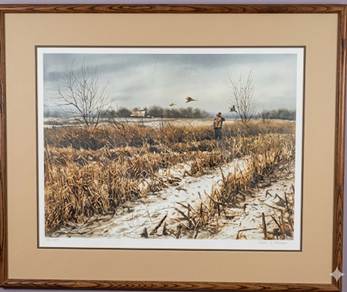
This is the picture. It could have been of me and my dog Rusty. In the distance is where the barn and Bob’s home would have been.
Law Enforcement in the North End
Unlike Mayberry we didn’t have a dedicated Sheriff’s office or a jail. Breedsville was too small for that. No Sheriff Taylor. No Deputy Fife. What we had was County Deputy Mike Mirabella, part of the Van Buren County Sheriff’s Office, patrolling the north end of the county — Geneva and Columbia townships. Breedsville sat in Columbia.
Mike was essentially a resident deputy. He lived a few miles east of town and his job was road patrol. Serious crime was rare. Most calls were traffic accidents or medical emergencies. It was quiet work in a quiet place and that suited everyone just fine.
My eight-year-old memory of Mike is that he bore a strong resemblance to the sheriff Jackie Gleason played in Smokey and the Bandit — Buford T. Justice. Perhaps I’m being unkind. But that’s the honest memory of a young boy and I’m sticking with it.
Mike drove the classic black and white Plymouth Fury with red lights fixed to the roof. You could see it coming from a long way off. That was probably the point. Be on your best behavior. He would cruise through town, stop in at Grandpa’s store, drop a few fresh Most Wanted posters at the post office, and move on. In full uniform with a pistol on his hip and handcuffs on his belt he cut an impressive figure for a young boy. I suspect he rarely needed either.
When someone got a little too friendly with a bottle on a Friday night Mike’s approach was practical. If you were a local he would more often than not let it go with a warning. Sometimes he would simply escort a tipsy resident home and call it done. He was keeping the peace in the way that made sense for the community he served. People respected that. They respected him.
It was a different time with different values. People had a healthy regard for law enforcement and law enforcement knew their neighbors. That relationship meant something. It made the whole arrangement work in a way that’s harder to find today.
Deputy Mirabella had it relatively easy. I don’t envy the men and women who do that job now.
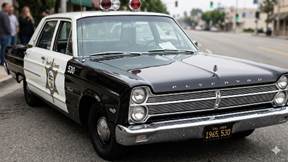
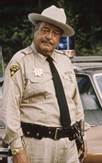
This Plymouth Fury is exactly what Mike drove This picture of Jackie Gleason as Buford T J Justice looks eerily like a thinner Mike.
Our Community of Color
Tom Charleton
Dad’s job as a rural gas serviceman took him down a lot of country roads. He used those drives well — watching fields and fence rows during summer months, noting where the pheasant populations were building. One farm that consistently held birds belonged to Tom Charleton, about five miles west of town. We hunted there often.
Tom was a Black man, soft-spoken and deferential in the way that was common among Black men of that era in rural Michigan. I sensed something beneath the deference though — a weariness, a weight he carried. I never learned his history but I felt it was a hard one.
He was also one of Grandpa’s regular customers. I saw him often at the store. When he came in I would call out — Hi Tom! He always answered the same way. “Fine, fine Bobby.” I thought it an interesting response to a greeting that hadn’t asked how he was. Then he would turn to Grandpa. “Mr. Walt, I’d like two big ones and three little ones.” Two quarts and three twelve-ounce cans of Stroh’s. Then he would head home. The fact that he called Grandpa Mr. Walt was a sign of respect. Many customers did the same. It was a carry-over from an earlier time that nobody questioned.
Tom lived in a loose enclave of Black families settled west of town. Perhaps twenty families in a five to eight mile radius, on farms and small parcels of land. Many had come from Chicago, Gary, or Benton Harbor. Some families had been there for generations. Others had arrived more recently, drawn by the same thing — a safer, quieter life away from the pressures and dangers of the city. They wanted better for their children. Their kids would later be my classmates and teammates at Bangor High School.
I learned to judge people by the quality of their character rather than the color of their skin from my grandparents. This was not accidental. Grandma and Grandpa had experienced prejudice themselves in Indiana. They were Polacks — a word used without kindness in those days. Grandpa told me that Polish ballplayers had struggled to break into the major leagues in the thirties and forties because of their names, that families changed their surnames to sound more American just to get a fair chance. Whether every detail of that story holds up I can’t say. But the lesson behind it did. They knew what it felt like to be looked at sideways and they chose not to pass it on.
Walt’s served customers of all backgrounds and my grandparents treated every one of them the same way. I watched and I learned. I’ve wondered since whether their Mason and Rebekah membership shaped that openness or whether they were simply good people drawn to societies that reflected values they already held. Probably both.
Our village was not without its biases. No place was. But they never got in the way or out of hand. I’m sure it was difficult to be a Black person in that time and place regardless of how decent your neighbors tried to be.
Years later as a basketball player I got a small taste of what it felt like to be the only one of your kind in the room. I was often the only white boy on the court in the pickup games I sought out. It was uncomfortable at first. But I was respected for how I played and that respect meant everything. During my high school years the local chapter of the Black Panthers presented me with what they called the Certificate of Spade — an acknowledgment that I played like a Black man. It meant more to me than any All-State honor. It was acceptance, freely given, and I have never forgotten it.
Back to Tom.
One evening Dad and I arrived at his farm for the hunt. Walking out behind the house I stopped at the sight of a pile of Stroh’s bottles and cans stacked nearly five feet high. I stood there looking at it. I felt the loneliness and isolation it represented — a man numbing something that didn’t go away. It explained why he was always genuinely glad to see us.
Dad surprised me on those hunts. He was kinder to Tom than I expected — patient, attentive, never in a hurry to leave. As we headed out to the field Tom would sometimes say quietly — if you get a nice tender one, I’d appreciate it. This was a request for a hen. Illegal, yes. But the bird would never leave his property and it would give him a good meal. We always accommodated him. My first pheasant was a hen.
Years later when Dad passed, several young Black men and women came to the visitation. A couple of them found me and said your dad was always good to me. He took the time to talk and had a kind word. I appreciated it. It was a side of my father I had never seen at home. Whatever complicated man he was inside our walls, he was something better out in the world. I took note of that.
Other Families
Grandpa had many customers of color over the years. Names like Scoggins, Quinn, Elam, Johnson, Byrd, Bynum, Savage, McKeever, and LeFlore came through the store regularly. They were as varied as any group of people — some dignified and formal, some easygoing, some transactional, some who would talk your ear off if you let them. In other words they were exactly like everyone else. They wanted to live in peace and raise their families. Grandpa treated them accordingly. So did I.
Hollis Byrd
Whenever I was hanging around the store with Grandpa and saw Hollis Byrd coming up the walk I would smile — especially if no other customers were inside. I knew what was coming.
Hollis was a big jovial Black man who lived a few blocks east of the store in a small flat attached to a vacant building that had once been a restaurant. It sat on a little hill above the river. There was a path behind it I walked often, following the bank and exploring.
Hollis would come through the door, reach into his pocket, and pull out a lockback knife. He would flip it open, crouch down, and swing it in front of him. “I’m gonna cut you Walt.” Grandpa would reach behind the meat counter and come up with a big butcher knife. “I’m gonna cut you Hollis.” Then they would both break into laughter, put the knives down, and settle in for a conversation. Town news. World events. The small important things going on in each other’s lives.
Hard to imagine that exchange today. It would read as something entirely different in the current climate. Harder still to imagine what some unsuspecting customer walking in mid-routine would have made of it. But that was our little town. Two men who knew each other well enough to joke that way. The joke only worked because the friendship was real.
After the laughter settled Hollis would pick up a few things for dinner. Before he left Grandpa would remind him — Hollis, you going to put something on your ticket? Hollis would wave it off. Getting my check this week. I’ll be back.
Grandpa kept a credit tab for his regular customers. A small book for each one with carbon paper inside — he would write up the charges, hand the customer their copy, keep his record in the book. Many people lived check to check. I never thought of them or us as poor. Grandpa was simply helping his customers bridge the gap between paydays. He never charged interest. I never remember him taking a loss on it either. It built a loyalty that no discount or promotion could have bought.
It reminds me of something Katie said when she was about seven. We were at Grandpa Rocky’s and she spotted a coffee mug on the shelf that said Standard and Poor — the debt rating agency. She had just learned to read. She studied it for a moment and asked Barb — are we Standard or Poor? Barb turned it back on her. What do you think? Katie considered it carefully. I think we must be Standard because I don’t think we’re Poor. She has always been a thinker. But it also reminded me that children don’t carry a concept of rich or poor until the world gives it to them. There is probably something worth protecting in that.
Back to Hollis. Each time he left the store we shook hands. But it wasn’t a regular handshake. As we clasped he would scratch my palm with his finger. The first time it was unexpected and disconcerting. Once you knew it was coming it became part of the ritual — his way of saying something without words. He would let out a big laugh, say goodbye, and walk home.
Years later playing basketball in high school and college I encountered all manner of elaborate handshakes among my Black teammates and playing partners. Each one was a kind of acknowledgment. I see you. I recognize you. You belong here. I think that is what Hollis and I had between us — an acknowledgment that crossed whatever distance might otherwise have existed between a young white boy and an older Black man in a small Michigan town.
I would sometimes walk part of the way home with him since his place was on my route. Looking back it seems unremarkable — two people walking the same road. At the time it was unremarkable. Race was simply not a consideration between us. We were neighbors.
I realized something while writing this. Hollis, and most of the old folks I visited in those years, had no cars. Our little town was the entirety of their world. They lived there. They would die there. They would be buried in the small cemetery on the edge of town. They were not passing through or biding time somewhere else. They were simply and completely part of that place.
We were a community. A real one. I would never find it’s like again.
Hattie and Ira
Two people I was always glad to see come through the store door were Hattie and Ira Elam. Their arrival meant one thing — they were heading to the river for the day and I was going with them.
They were a middle-aged Black couple who lived outside of town. Always pleasant, always kind to me. Hattie wore long dresses and wrapped her hair in a bandana in the way common among Southern women of her generation. When they arrived at the store they would pick up snacks and drinks and head down to the river, only a couple hundred yards away.
A gravel road ran down the bank to the dam. You could drive to the bottom and park. The old bridge crossing there had lost its boards years before — only the metal framework remained. It had a big spill pipe, maybe six feet in diameter, and boys would sometimes climb out onto it and fish the river below. I was jealous every time I saw them do it.
The dam created the millpond with the river channel running along the shoreline. It was an ideal spot for a day of fishing and that is exactly what Hattie and Ira had in mind. Every time they came Hattie would ask — Bobby, are you going to join us? The answer was always yes. Looking back its a little surprising my family entrusted my care to Hattie and Ira. Once again, I was “colorblind.”
They fished old school. They would find a good tree along the bank, set up their chairs, and work twelve-foot cane poles with an equal length of line and a bobber. Simple and unhurried. It was exactly how Dad had described fishing Munson Lake with his grandpa Ben as a boy. The old way.
For Hattie and Ira I think the fishing was mostly an excuse to sit by the water and let the day go by. They were patient in a way I was not. Over the course of a day they would collect a handful of bluegill, sunfish, the occasional bass or catfish. It seemed to be exactly enough.
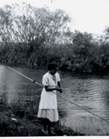
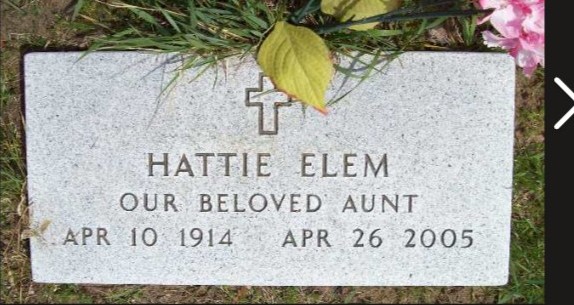
This is how we fished. A nice relaxing slow-paced day at the river. No this is not Hattie, but it could have been. Very similar. I found their gravestones at the old Breedsville Cemetery.
I would run back and forth between the store and the river all day. Check their stringer, sit with them for a while, chat, then head back. I was too young and too restless to stay put for long. They never seemed to mind. They were patient with the inquisitive boy who couldn’t sit still the same way they were patient with the fish. Quietly, without making a point of it.
Years later Grandma mentioned that Hattie and Ira enjoyed their weed. This was the early sixties, before it carried the cultural weight it would take on later in the decade. Among certain older folks it was simply what it was. It explained a great deal about their particular brand of tranquility by the river.
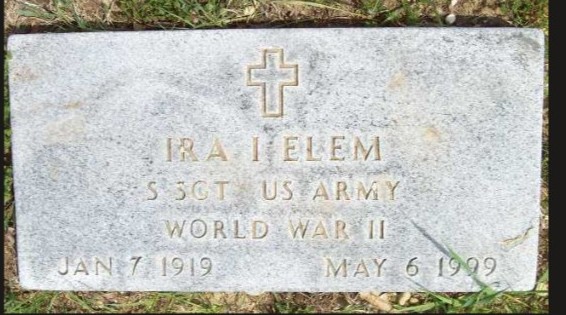
I grew up and moved away and Hattie and Ira faded from my active memory the way people do when enough years pass. Then in the mid-2000s I came back to Breedsville and walked through the little cemetery on the edge of town. I found their stones side by side. Hattie had died in 2005 at ninety. Ira had preceded her by about seven years. Beside his name the stone noted his service — United States Army, World War II, Sergeant. I stood there for a moment with that. A man who had served his country honorably, come home to rural Michigan, and spent his remaining decades fishing a millpond with his wife and letting a young white boy tag along. He had earned every quiet afternoon by that river.
I wonder how many years they continued their weekly fishing trips after I left our little town. I also wonder If they ever caught that “big one.”
They rest together now in the shade of a big oak on the bank of the Black River
I have thought about where they might have chosen to be buried if the choice had been entirely theirs.
I think they are exactly where they would have wanted.
I remember them fondly.
Our Special People
Every town has its special people, the ones who face challenges most of us will never understand. They are different physically and mentally the from rest of us. Even as a small boy these differences are noticeable, though not understood. But we accepted them as part of our community.
The following are a few I grew up around.
Eddie
Eddie came into Grandpa’s store daily. He suffered from a severe case of club foot. He was probably in his late 30’s – early 40’s. He could barely walk. Swinging his arms and legs he was able to walk 15-20 feet. But he had managed a way to move around town. He had an old girl’s bike. He could get his legs to the pedals and had the balance to slowly ride from home to downtown.
Each day he would ride down the street the 1/4 mile to town. He would stop to get the mail and at Gramp’s store for the daily paper. He and Gramps were Cubs fans. Two of the long suffering. Diehards, they followed the lowly cubbies who had not won a world series since the 1940’s and would not win one during the remainder of Gramps life. But this was their team, Ron Santo, Billy Williams, and Mr. Cub Ernie Banks who always said. “It’s a great day, let’s play two! Meaning a double header. Each day they would commiserate about the Cubs and their latest loss and prospects for a better year. “Wait till next year!” was a typical Cub fan refrain.
.Eddie also had a speech impediment that made him a bit difficult to understand. As a young boy I never really thought about his limitations he was Just Eddie.
Stopping by was part of his daily routine. A routine to us, but central to his ‘life. Looking back now I realized that if Eddie had been born today, they would have fixed his deformed legs and he could have had a more normal life instead of being cursed with his affliction.
How different would his life been? I never heard him complain, but I wonder how he felt about being trapped in a broken body. How different would it have been to be a normal boy, going to school, playing. doing young boy things. Potential never realized.
But Eddie was a lesson in perseverance and doing the best he could. He never sought sympathy only acceptance. He found it in our town.
Freddie
Freddie was also a special person. He had a mental disability. In those days it was called mental retardation. He lived just up the hill from the town center. He was a regular downtown.
Even as a young boy I noticed he was different. He was probably in his mid-20’s, tall, thin, long face. He was social and friendly but struggled with sensory over load. Today I think he would have been diagnosed with Fragile X syndrome.
He lived with his mother and would do the occasional odd job often helping my grandpa’s competitor with tasks around his store.
It was difficult to interact because he was different. He wanted to be social and get attention but it was hard for me. Short conversations and move along. I could not wait for them to end. It was uncomfortable.
Sadly, many young boys would tease and taunt Freddie. He was an easy target. While they thought it was funny, even at a young age it felt wrong to me be cruel to someone so vulnerable.
Freddie would often say to me “You’re a good boy Bobby.” I think he realized how he was being treated and how I never participated in the antics of the others.
He may have had a mental disability but he was a person who had feelings who was an easy target. It also was a lesson that even a little kindness can mean a lot.
Ronnie Savage
I first saw Ronnie Savage when I was about ten years old. We were at a Bangor High School basketball game. I stared. I had never seen a little person before. He stood just over four feet tall but was stout — probably two hundred pounds on that small frame. I didn’t know it then but Ronnie would be part of my life for the next twenty years and would become one of the most memorable people I ever knew.
Ronnie was a Black man who lived west of town with Habakkuk McKeever and his half-brother Pompeii. In those days the word people used was midget. He wore it without complaint. He didn’t have much use for self-pity.
He was a fixture at Bangor sporting events for decades. Football, baseball, track — Ronnie was there for all of it. On the sidelines for football games. Behind home plate for baseball. Working the stopwatch at track meets. But basketball was his true love. At games he sat at the scorer’s table — keeping score, recording stats, running the clock. He was in the locker room before and after games. He showed up to practices. He didn’t view his size as a limitation. He was just like us, only shorter. Much shorter.
To call him a mascot would be an insult. He was an integral part of every team he attached himself to. Players and coaches came and went over the years. Ronnie was the constant.
When I became a key player on the basketball team our friendship deepened. Ronnie was a devoted UCLA fan during their dynasty years. At that time UCLA had a forward named Lynn Shackleford — a deadly outside shooter. Ronnie decided I reminded him of Shackleford and started calling me Shack. The name stuck through all of high school and beyond. Fifty-five years later old friends and hometown people still call me that. Every time someone does I think of Ronnie.
Katie, there are things about your father’s athletic career you may not know. I was an All-State basketball player. I won eight varsity letters across multiple sports. I was part of the first class inducted into our high school Hall of Fame. I share this not to boast but because it’s part of the story — and because Ronnie was part of what shaped it. He believed in players and pushed them to be better. I was one of them.
In the summers our high school team played a scrimmage league against surrounding towns. There was no team bus and parents weren’t as involved in those days. Ronnie would load his car with players and drive us to our games himself. He had the pedals specially built up so he could reach them. I was often the only white kid in the car. We would talk about the team, argue about who was going to have a big game, and listen to Motown and soul on the radio. Ronnie had a favorite — an instrumental called The Horse. He would turn it up and we would ride. Those drives were some of the best times I had in those years. Simple and easy and full of laughter.
Beyond the games Ronnie coached Little League and Pony League baseball. He was at recreational events all over the area. He devoted himself to young people — to making them better players and better people. He never made a speech about it. He just showed up, year after year, and did the work.
When I came back to town in later years Ronnie would spot me across a gym or a field and call out — Shack! Good to see you, how have you been? That never changed no matter how many years had passed.
When Ronnie died the town named the baseball field after him. A plaque recognizing his contributions hangs at the entrance to the basketball gymnasium. He would have been embarrassed by both. He never set out to leave a legacy. He just gave what he had, year after year, to the kids and teams of Bangor. The legacy took care of itself.
I once heard it said that people won’t remember you for your accomplishments. They’ll remember you for how you made them feel. Ronnie was the proof of that. My All-State honors and Hall of Fame induction are things I am proud of. But they don’t hold a candle to what Ronnie Savage meant to the sports community of Bangor over his lifetime.
A friend told me when Ronnie passed they held a memorial at the High School gym. He said it was standing room only. Just like our games against Covert it was packed. Ronnie would have been amazed at the people who showed up in thanks for all he had done for our sports teams and young people over the decades. His star still shines brightly.
He had the heart and spirit of a six-foot-eight, two-hundred-and-twenty-pound athlete packed into a four-foot frame. I was blessed to have known him.

 Growing Up All Over Again