Here are a couple of entries from our first winter at the lake after buying the cottage in September.
Entry 5: The Initial Bivouac and the Winter Ritual
We spent every fall weekend at the cottage. We personalized it. We swapped some furniture. A sleeper sofa with a Native American design was a key purchase. It faced the fireplace. We could sit together. The cottage had a well pump and a gas heater. We did not trust them. Technology failed in remote areas. We reverted to fire.
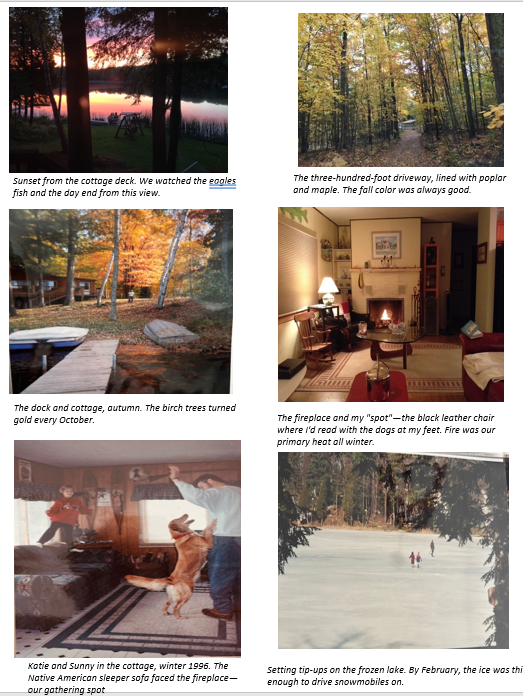
The fireplace was central. Red brick with a mantle. Paneling was glued to the chimney. Blowers pumped heat into the room.
We replaced the seller’s bear skin above the mantle with a Terry Redlin print—“Hunters Haven.” It fit the decor. Redlin always showed the warm glow of fire.
The fireplace was open. It needed a screen. It would contain sparks and manage the draw. This was the first “TO DO.” A brass, glass, and chain screen was acquired and affixed to the hearth.
The brick fireplace drew poorly. I smoked us out with the first fire. Opening the flue was a must. It would not happen again.
Starting a fire became customary in fall, winter, or early spring. The crackling wood created a cozy feeling. Returning from the lake or ice, the smoke and the glow through the window was a welcome sight.
We gathered bundles of twigs and pine cones dipped in wax. They were excellent fire starters. Sunday newspapers helped warm the chimney quickly.
In winter, fire was primary heat. Burning all day, the brick warmed and retained heat. The furnace rarely came on.
I cut and split much of the firewood. My dad said a wood-based fire warms you four times: when you cut it, split it, stack it, and burn it. There was satisfaction.
A black leather chair stayed by the fireplace. It became my “SPOT.” I would sit and read. The dogs were at my feet.
The pipes could freeze. We avoided indoor plumbing. We drained the pipes and winterized the cabin. We paid the physical tax instead.
This was the Ice Tax Ritual. I walked to the lake. I chopped the ice with the axe. The dark water steamed in the cold. I hauled the heavy buckets up the hill. The water was for flushing only. It was an honest trade. Hauling the water was everything.
On one of the first trips, Katie and I scooped water. A small fish was on the ice. A minnow with a long dorsal fin and a spot on its tail. It was a bowfin (dog fish). We rescued it. We put it in a jar. “Spot” was a family pet for a few years until he was released into a lake. He was a constant reminder of the lake. He was the first of many wildlife experiences. Finally, we released him to a large lake.
***
Entry 6: The Winter of Small Wonders
The first winter was less about the hammer. It was more about the landscape. We were learning how to live in the place. The land had a personality. The Ice Tax Ritual continued. It was the backdrop for exploration.
The woods, a green wall in summer, opened under the snow. We snowshoed the 80 acres. We learned the deer trails. We found the hidden ponds.
We started a simple aesthetic project: feeding the birds. We built simple wooden feeders that hung between two Hemlock trees. The trees provided the birds a perch and protection from the elements. Also hanging the feeder between the trees discouraged the squirrels a bit, but they are ingenious little devils. We filled the feeders each weekend and when we returned the following week, they would be empty. Cardinals, chickadees, and nuthatches against the white backdrop welcomed the free handout, and sunflower seeds were high cuisine for them.
These were small victories. A bird fed. After a time, Katie and I would sit out on the deck with sunflower seeds in our gloved hands. The Chickadees were the most curious and brave. After a time one little bandit took a seed from our hands. He returned again, and shortly after that his buddies joined him. Katie was beginning to experience the wonders of Nature. There would be many more rich experiences over the years. We even installed a clear window feeder right on the glass, giving us an up-close, high-definition view of these tiny personalities, especially our favorite little “bandit” Chickadee, snatching a seed and flying off.
***
Entry 7: Fury Hill
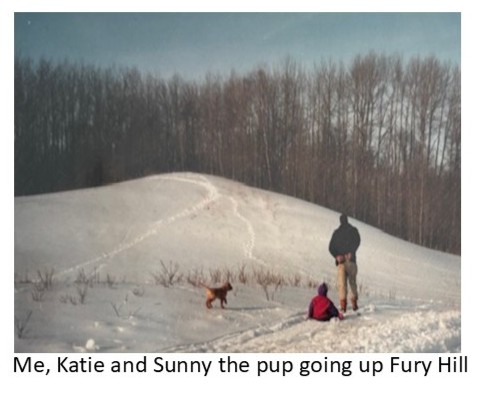
Our first Winter at the lake we were introduced to “Fury Hill.” It was a slope the lake kids (now grown) had sledded over the years. It was the kind of hill where a fast run, a plastic saucer, and a little bit of bad judgment made for the best day of your life. It was reached by following a path through the 80-acre woods. It was a long steep slope. One winter day we had a once-every-10-year weather event. Overnight a rain that covered deep snow—followed by a flash freeze. The result was an ice coating on the snow strong enough to hold our weight. Perfect for sledding/sliding.
So, with snow saucer in hand and pulling Katie on a small plastic toboggan, we trudged to the hill. Katie was little, 5 years old. We had just gotten a new puppy. Sunny was a Golden Retriever and joined us. She was just a pup.
Once we got to the hill, we discovered climbing it on the ice crust was a challenge. Sunny with her claws could scamper up the hill. But Katie and Barb could not ascend the slippery slope. I had to break trail through the crust to form a path.
Once at the top, our first trip down was Katie. She started down on the ice crust and continued to gain speed. The 100-yard descent happened rapidly, Katie howling with delight as she sped down. Barb and I were TERRIFIED. Today we would be considered irresponsible parents. But this sledding event was tame compared to what Barb and I experienced in our youth in the late 50’s and 60’s. We quickly decided a slower descent was the wise choice.
Over the years Fury Hill provided a lot of winter fun, but we never again experienced the ice crust of our first trip. It was a once-in-a-lifetime event for us all. Sadly, as the years went by the property was sold and a home built at the base. Fury Hill was a victim of progress. Like so many other things it is now a memory of the past, a victim of time. But the memories remain etched in our mind.
I have finally finished the memoir that I have been posting excerpts from. It’s been a fun project. Claude AI was my editor and I used Kindle Digital Printing to get it in print. At this point I don’t plan to offer it for sale to the general public. It was a bucket list item to write a book. I can check this off. I will likely post a couple more excerpts and then ride off into the sunset. Hope you have enjoyed the stories I have shared
We had an amazing ecosystem at Little Bass Lake. The lake was spring-fed and pristine, home to an abundance of fish and aquatic life. The mature eighty-acre forest was home to woodland creatures. There was a swampy area at the west end, a place for the marsh dwellers.
You need only be a keen observer to take in the wonders of nature. This was Katie’s biology lab, the ideal learning environment. It was wondrous for us all.
Deer
You can’t talk about northern Michigan’s nature without talking about deer. We had our share.
During the winter months when the lake was iced over, several neighbors provided feed for the deer. One resident brought in large hay bales and placed them on our access road near the eighty-acre woods. Another neighbor, Mark, had a spreader set on a timer to scatter corn at dusk.
If you were on the ice late in the day, you’d see the deer start to emerge from the woods. Soon there’d be twenty to thirty racing to Mark’s to feed. It was like clockwork and an amazing sight.
It was also a signal to us fishermen. The bite was going to start. Our lake had an evening bite around dusk. Often as the deer loped across the lake, we’d start catching fish. The deer signaled feeding time for the fish. More than once during this short window, we’d fill our limit.
One year Tom and his friend Dan were bow hunting. Just before dark, Tom shot one—a solid hit with a blood trail. They tracked it into the night. When you’re tracking, you lose your sense of direction. Even the eighty acres look very different in the dark. Tom and Dan were lost.
Fortunately, Tom had his cell phone and a signal. He called Mark, who came out with his four-wheeler and rescued them. They found the deer the next day. Of course they were teased viciously about getting lost. Now they have GPS.
Among hunters there’s a story: When lost in the woods, you’re supposed to shoot three times into the air to signal you need help. The story goes a hunter was lost in the woods. When he was found, they asked, “Why didn’t you shoot into the air?” He replied, “I did, but then I ran out of arrows.”
Deer hunter humor.
The Big Buck
Supposedly there were big bucks in our woods. I’d never seen one. Lots of spikes and does. That changed one fall day.
I was looking across the lake and saw a disturbance on the water. On closer inspection I saw a massive twelve-point buck swimming across the lake toward our shore. I ran and got my camera. When he got thirty yards from shore, he saw me. He turned and swam back.
I watched for ten minutes. Finally, he reached the north shore. Exhausted, he got out of the water and stood there. He was majestic. I could see his breath in the cold fall air.
I wondered why he’d decided to swim across the lake. I suspect he was fleeing a hunter. I watched him until he turned and sprang off. I wished him well. I hope he made it through hunting season and sired some offspring.
I Save a Deer
I’m not a deer hunter. It never appealed to me. I did, however, have an up-close encounter with one.
I was driving down a gravel road to a nearby store. On each side were deep ditches filled with water. It was early March. Something caught my eye. I stopped.
A young doe was in the middle of the ditch, stuck in the mud. It couldn’t free itself. I had to help.
I got out and walked along until I found a place to cross. I was leery about approaching her—I’d heard stories how violent deer could be. But it was clear this girl was exhausted.
I edged closer and slipped my arms under her belly. She let me pick her up, freeing her from the mud. She couldn’t have weighed sixty pounds. Once on shore I set her down. Her legs were numb. She was wobbly.
Should I put her in the truck? I worried that once she warmed up, she might go wild inside the vehicle. I made my decision. I was ten minutes from the store. I marked where she was. On the return trip, if she was still there, I’d take her home.
When I came back, she was gone. I hope she survived the spring. At a minimum I helped her survive the day.
Aquatic Mammals
We had muskrats patrolling the shores, slipping under docks, doing what muskrats do.
We had two special visitors over the years: an otter and a beaver.
The otter was a fishing machine. We’d see him floating on his back eating fish. I heard they can decimate a fish population. Fortunately, after a week he decided to leave for greener pastures. I was happy to see him go.
Our other visitor was the beaver. They’re rarely seen up here. This fellow was fun to watch swimming across the lake, often slapping his tail on the water when startled. I think he had designs of damming our little outlet stream.
Though he was fun to watch, he posed a problem. He started attacking neighbors’ trees. It’s amazing how quickly beavers can fell a tree.
I would have preferred to relocate him, but someone took things into their own hands. He was eliminated. I was saddened but understood. He could have done irreversible damage to the mature trees along the water’s edge. Some visitors are not welcome.
Cuff had his muskrat experience. One man on the lake was an old-timer trained in small engine repair. He was our go-to guy for chainsaw, mower, and leaf blower repair. He trapped muskrats. There’s still a market for their hides. My dad had trapped them as a boy to make money during the depression. I remember his stories.
I had a chainsaw that needed work. Cuff came with me to Bob’s garage. We walked through the door. Cuff looked up—he was facing four muskrats hung by their tails. He let out a whoop and jumped back. I’m sure he had to change his shorts when he got home.
Another city dweller.
Turtles
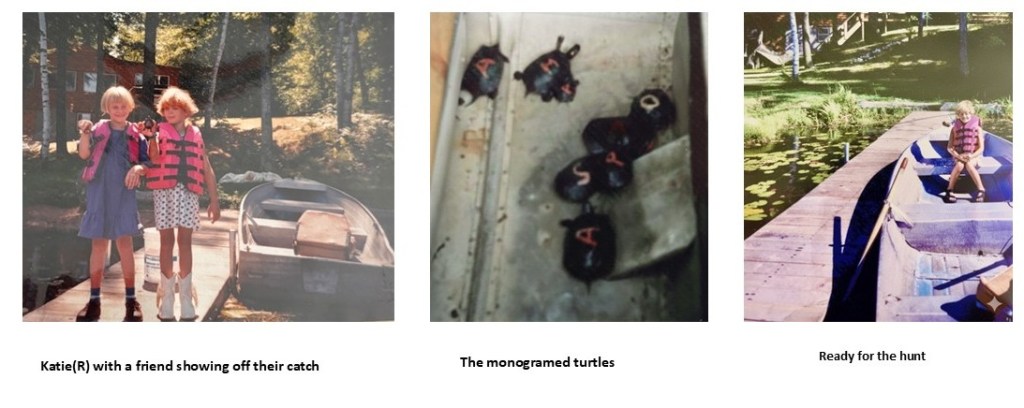
We were well acquainted with the painted turtles. We’d caught and numbered many. It was a favorite pastime for Katie. We enjoyed seeing them sunning themselves on logs or swimming by, identified by the numbers on their backs.
I’m certain by now when they heard the little paddleboat, they were saying, “Dive! The girl with the net is coming.”
The painted turtles gave Katie another biology lesson. In the spring they’d leave the lake and head up our driveway to the gravel pit. There they’d find a sandy spot to lay their eggs. We’d watch the mother dig her hole, lay the eggs, and cover them with sand. The warm sun would incubate them. Empty shells several weeks later signaled they had hatched.
We also had huge snapping turtles at the lake. They were only seen occasionally. A telltale sign of a snapper would be a stream of bubbles on the water’s surface, like a scuba diver. These snappers were aggressive hunters. More than once, I’d see a mother goose start with a flock of six goslings. Slowly that number would decrease. The snappers would come up under the goslings and that was it.
These snappers could get large. Often their shells would be larger than the bottom of a five-gallon bucket. And their jaws—they could snap a stick as big around as a broomstick handle. They were not to be trifled with.
One time Bob Norin allowed a man he met at Charlie’s Bar to set turtle traps to thin out the snappers. The story goes he got three to five big ones each day of the seven-day season. He’d make soup and would sell the remaining meat to restaurants in Chicago. I hear it’s good. We were happy to see the population culled. We never had a human-snapping turtle incident. We wanted to keep it that way.
Frogs and Snakes
On our first visit to look at the cottage, we saw hundreds of little micro toads in the lawn. It was a good sign of a healthy environment. Each year we’d see their numbers again, though I suspect the little guys were easy pickings for snakes and birds.
We had bullfrogs with their deep voices calling out in the evenings, joined by the little peepers in the wood ponds. A regular choir. There were leopard frogs and tree frogs as well.
When we were first at the lake, we had trouble with snakes taking up residence on our dock. Once the eagles arrived, the snake numbers decreased. Eagles like snake dinners. The balance of nature was playing out.
Squirrels and Chipmunks
We had no shortage of squirrels or “micro bears”—chipmunks. Most of the squirrels were of the fox or gray variety. On winter evenings we occasionally saw flying squirrels at our bird feeder.
The red squirrels were a nuisance. There’s a reason there’s an open season on them. They’re cute but destructive as hell. We had our own personal war.
Things came to a head one day. First one gnawed a hole in the exterior wall of my sauna. If that wasn’t bad enough, when Barb would take the laundry down to the basement, the little devil would jump out, stand on his hind legs, and try to keep Barb from going in.
That was the last straw. I borrowed a pellet gun and began thinning them out. Finally, they got the message. They followed the good neighbor policy. They took up residence at my good neighbor Cuff’s house.
Micro bears. We all loved the chipmunks, especially Trixie. They were entertaining little scamps. They’d fill their cheeks with sunflower seeds to the point of exploding, then add another couple. Then it was off to a woodpile, unload, and come back for more.
As a special treat we’d let Trixie chase them. She never caught one, but she instilled fear in many.
The Others
There were other woodland creatures we knew were there but seldom saw. In the evenings we’d hear coyotes howling. We worried for Trixie and Miffy.
We also had fox. Occasionally we’d see one, but they stayed out of sight and avoided humans when they could.
The neighbors had encounters with a black bear. Usually, he’d raid the bird feeders. They said he was a big boy. We never saw him, but we did see the damage he did to the feeders.
Of course, no woodland would be complete without raccoons and possums. We didn’t like the former but appreciated the latter for their tick eating. Popular opinion is they’ll eat five thousand ticks per season. Studies don’t bear this out, but we figured they’re harmless and maybe they do some good.
Our lake had a healthy wildlife population. Over the years they entertained and sometimes amazed us, and sometimes frustrated us. But on balance we all got along well.
They were there before us.
Katie’s Biology Lab
The best part: Katie got a glimpse of what it was like for me as a boy growing up in the country. No iPhone, no internet, no video games. The great outdoors provi
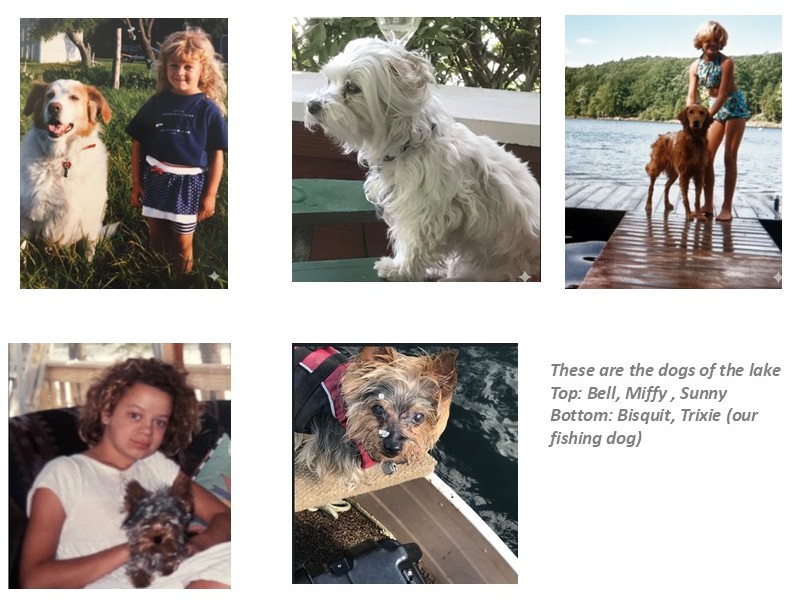
Barb and I are dog people. We grew up with dogs and they were part of our lives. During our forty-six years of marriage, we always had dogs. Many of them have their place in the history of Katie’s Cottage.
Rusty
Before the lake, I had Rusty, a Brittany Spaniel who laid the foundation for the dogs to come. A great hunter and companion, she never saw the lake, but she taught me what a good hunting partner could be.
Belle
One hot August day we were driving the countryside when two puppies peeked out of the weeds next to a ditch. Barb said, “Stop, stop!” I kept driving. Barb was relentless. Finally I turned around. Little did I know what was to come.
We got the pups in the car. One was white with butterscotch ears, the other black and white. They were desperate for water, started licking the condensation on pop bottles on the floor. They needed immediate attention.
We stopped at nearby homes. The pups weren’t theirs. Someone had abandoned them. I’m constantly amazed by the cruelty of our race.
We got them home, hydrated them, gave them flea baths. The white one looked covered with pepper as the fleas came off, crawling into her eyes. She whined. Same for the black and white.
We took them to a vet, got them treated, wormed, shots. Then we’d put them up for adoption. Barb asked the vet, “How big will they be?” He remarked, “About the size of your Brittany.” That was the last time he ever gave estimates on size. He added if we hadn’t rescued them, they’d be dead the next day.
We put an ad in the paper: Free puppies, wormed and shots. The black and white was adopted by a family whose little boy had just had heart surgery. He wanted a pet. Good home.
We’d grown attached to the white one, Belle. There was something special about this dog. She grew to one hundred pounds. She had all the markings of a Great Pyrenees and the temperament. Wicked smart. Almost like she understood us.
I needed a hunting dog. I taught her to bird hunt. The first time with live birds at a put-and-take farm, I thought I’d missed a shot. Belle ran after the bird. I called for her for over ten minutes, getting angrier. Then I saw her come out of the weeds, something in her mouth. The pheasant, still alive. She’d tracked it down. I had a hunting dog.
She was also a loyal protector. Good with family and friends, but if a stranger approached unbidden, she’d bear her teeth and give a low growl. Enough to stop someone in their tracks. She never bit anyone, but I’m pretty sure she caused some folks to soil themselves. I always felt Barb and Katie were safe when I was traveling.
Belle was our first dog at the lake. By the time we bought the cottage, Katie had been born and Belle was thirteen years old. She made it to the lake several times, but there are no memorable stories. When she crossed Rainbow Bridge it was a sad day. We’d never have another like her. She was special.
Biscuit
Biscuit falls into the category of a lake ARI—alcohol related incident. She was a Yorkshire Terrier, the first small dog we ever owned. Several more would follow.
I was at the lake with friends ice fishing. We’d eaten and were enjoying drinks, maybe a few too many. Allegedly, Barb called and said, “Katie and I have found an adorable puppy.” I allegedly said, “You should buy it.”
When I got home, there was Biscuit, a three-pound ball of fluff. Not recalling the conversation, I said, “It’s yours, keep it away from me!” Not one of my better moments.
Well, Biscuit had other ideas. Later that month Barb went into a store. Biscuit and I stayed in the Yukon. When she came out, Biscuit was on my lap. I said, “I hate to admit this is a cool little dog.”
She was Barb’s dog. Cute as a button, and she loved Barb. Several times someone would stop and offer to buy her. One lady offered twelve hundred dollars. This dog was not for sale.
Sadly, we later learned the mother had congenital defects which were passed on. We had her six wonderful years. She made it to the cottage for a few years, keeping Barb and Katie company. By that time, she was reduced to being a lap dog.
One funny incident: A neighbor had a yellow Lab named Tess, restricted by invisible fence. Each time we walked Biscuit, Tess would run to the edge of her yard barking and growling. One day Barb opened the front door and Biscuit ran out, turned down the street. Barb was in hot pursuit. Tess was sleeping in her yard. Biscuit ran up, jumped on Tess, and started biting her. Tess woke up, grabbed Biscuit, and tossed her just as Barb arrived. Biscuit turned and ran for home, Barb still chasing.
They say dogs don’t hold a grudge. I’m not so sure.
When Biscuit crossed the Rainbow Bridge it was a sad day. She’d enriched our lives like no other. Barb still misses her. Biscuit introduced us to Yorkies and set the stage for a Little Bass Lake legend. To this day I’m grateful for my drunken approval to buy her.
Sunny
After Biscuit we never had less than two dogs. Our next was Sunny. I’d always wanted a golden retriever—smart, good-tempered, often guide dogs. Good hunters and family dogs.
Sunny turned out to be something entirely different. We bought her Thanksgiving weekend from a family with a litter of pups. As she grew, she didn’t have the bulky golden physique. She was built more like a setter. High-strung and one of the most athletic dogs we’ve owned.
She was the best hunting dog I’ve owned. Great in the field, loved to hunt. My close companion for years. When I was at the cottage in my chair by the fireplace, she was at my feet.
She was my fishing partner. We hunted grouse on federal lands a few miles from the cottage. If not for the terrible fear of storms and loud noises—which resulted from the lightning bolt that hit our dock—she was a good girl.
She was not good at coming when called. Neighbors often heard yells of “SUNNY COME, SUNNY COME.” Cuff’s son-in-law Tom joked he thought that was her name: Sunnycome.
Katie and Sunny would play in the snow at the lake or go out on the ice to check tip-ups. One time I decided to try something. I attached a plastic toboggan to a rope and looped it through Sunny’s collar. I thought it would be fun for Katie to have a sled dog. A major surprise followed.
I took Katie, Sunny, and the toboggan to our side road and got Katie situated. Then I urged Sunny on. She took off like a shot, racing down the road reaching speeds of fifteen to twenty miles per hour. Katie was howling with delight. I was scared witless. Where the hell was this dog going? I was chasing behind and losing ground, fearful a neighbor might be coming down the road and meet an uncontrollable dog pulling Katie.
Finally, Sunny stopped at the bottom of the road’s hill. Katie had a thrilling two-hundred-fifty-yard ride. I wondered if Sunny was channeling a sled dog. This was the last time we tried Sled Dog Sunny.
I asked Katie what she thought of her runaway sled ride. She said, “It was great except Sunny’s claws kept kicking up ice chunks into my face.”
Mark this up to another Sunny story.
Miffy: The Gentle Maltese
Barb had been going through a rough patch. Her father had passed, she’d had rotator cuff surgery, and Katie was in Ireland on foreign study. I was spending a lot of time at work. She was struggling.
One day I came home and Barb said, “I stopped at the pet shop and saw the cutest puppy. Let’s go look at it.”
I believe when you stop to look at a puppy there’s a fifty percent chance you leave with it. I believe the odds increase to eighty percent if you go back a second time. In our case, I placed the odds at one hundred percent.
At the time we had two dogs. Sunny, who was fourteen years old—she and I were both retired from chasing birds in the field. Her time with us was coming to an end. A year earlier we’d added Trixie to the family. She decided she was my dog. Barb wanted her own. I knew we’d be leaving the pet shop with the puppy and be a three-dog family. I was okay with this.
When we arrived at the shop, they had one puppy. A tiny white Maltese. She looked too small to be separated from her mother. The salesperson placed her in a fenced area and Barb played with the pup. It was so small it could only hop. It was adorable. Barb loved it. We left with it.
Once home, the little pup immediately snuggled in with Sunny. She became her foster mom. The puppy would pester Sunny. She was tolerant and played gently with the little dog.
A couple days later I tried to get the pup’s attention. I called it. No response. I clapped loudly behind its head. No response. I told Barb, “They sold us a deaf dog!”
I insisted she call the pet shop. She relented and made the call. After she hung up, she glared at me. I said, “What?” She replied, “The pet shop said that dog isn’t deaf, lady, it’s just ignoring you!”
It was true. She wasn’t deaf. She had selective hearing.
When Barb and Katie spoke on the long-distance call from Ireland, Barb told her we had a new puppy. Her response: “What? You bought a puppy without me?” Not a happy girl.
Returning from Ireland a few weeks later, we met Katie at O’Hare Airport. We brought the puppy. Katie was lovestruck. We were absolved.
We had yet to name her. We wanted Katie’s input. She said, “It looks just like Miffy.” Miffy is a Dutch cartoon character, a white rabbit similar in appearance to Hello Kitty. Katie once had a Spanish language comic book featuring Miffy. She loved it. The name stuck. She was to be Miffy.
Maltese are the classic lap dogs, bred to sit on the laps of royalty. They’re well-tempered, calm, extremely soft, and loyal. The perfect girl dog. Barb and Katie now had their dog. We were now a three-dog family: Sunny, Trixie, and Miffy. Everyone was happy.
To say Katie and Barb doted on Miffy is an understatement. Miffy went everywhere with them and was always on their laps. We introduced her to the lake. Unlike Trixie, Miffy was content to be in the cottage with the girls. Of course, everyone who visited made a fuss over her.
One of the cutest stories involves a neighbor’s grandchild. He’d picked Miffy up and was carrying her around. Miffy was tolerant. The child came over to Barb and me and said with newfound discovery, “Miffy is so soft. And you know what? She has a tongue!” From the mouths of babes.
Miffy didn’t have adventures at the lake like Trixie. One day, however, we had a panic. We were in town twenty miles away. A windstorm had kicked up. We got a call from a neighbor saying they had Trixie. Barb was frantic. She was sure Miffy was lost, too young to survive. We raced home. Barb was in tears.
When we arrived, I saw Trixie cruising the lake with my neighbors on their pontoon boat. Sunny was laying on the deck. Our porch door was wide open. There was Miffy, laying on the couch. I’m sure she was thinking, “No way am I going out in that storm.”
She was the ultimate chill dog. A regular companion to Barb and Katie, Miffy had an eventful life. She spent one summer with Katie while she was doing a summer project banding hummingbirds in southern Arizona. The people leading the project had wolf-dogs. Miffy blended right in.
She also spent a summer with Katie at Grandpa Rocky’s just before Katie started grad school. One time several years earlier, we were at Grandpa Rocky’s for the Fourth of July weekend. Barb and Katie dressed Miffy up wearing a red, white, and blue starred top hat and a vest. We went into the resort town of Harbor Springs to attend the best small-town parade in the state. While walking down the street, Miffy in full costume, a man stopped and asked, “What’s your dog’s name?” Katie answered, “Miffy.” He said, “How fitting!”
One year I was in California in the hospital. It was Thanksgiving time. Barb had flown out to care for me. Katie was in her PhD program at MSU. That year she came to the lake with Miffy and spent Thanksgiving there. A lake friend invited her for Thanksgiving dinner. She and Miffy had their special holiday together at Katie’s Cottage.
Miffy never matched Trixie’s exploits at the cottage, but her disposition and charm endeared her to our friends at the lake. Most important, Miffy filled a hole in Barb and Katie’s hearts left when Biscuit passed. She was the only pet shop dog we ever owned.
Trixie: The Amazing
Every dog owner will have that special dog—a companion, a soulmate, an integral part of your life. Trixie was mine.
Biscuit was in failing health. We knew she’d be crossing the bridge. This would be an emotional loss for us all, especially Barb. To help ease the pain we knew was coming, we started the search for a new puppy. Biscuit would have a little friend, and the transition would be less painful when she passed. Our new puppy would be a Yorkie. I was sold on the breed thanks to Biscuit.
Barb and Katie began a search and found a breeder in a neighboring town. They did the initial visit and told me they’d found our girl. We always had female dogs—better temperament, more family-oriented.
When we got to the breeder’s, I saw they raised Rottweilers and Yorkies. A strange combination. Though Yorkies are said to be big dogs in little dog bodies. This was the case with our new puppy.
I saw her and it was love at first sight. Yorkie puppies are adorable. She was no exception. We closed the deal, wrapped her in a blanket. She rested in Katie’s lap and we began the drive home.
On the way back we discussed names. We settled on Trixie. It was a variation of Tricki-Woo, a dog featured in James Herriot’s “Dog Stories.” Tricki-Woo was special. Trixie would be too. How special, we had no idea.
Trixie was to be Barb and Katie’s dog. She had other ideas. People don’t choose dogs. Dogs choose people. Trixie chose me.
Early on Trixie displayed intelligence and athleticism. She learned many tricks easily. Her athletic ability amazed people. At dog parks she’d easily navigate the big dog agility course, leaping over high bars. She was only six pounds and stood eight inches at the shoulder. We’d throw a racket ball that would bounce several feet in the air and she’d leap high to catch it on the bounce. People would stop and stare.
We still had Sunny at that time. The two got along well, but Trixie was the boss. She was now part of the family. Katie and Barb had hours of fun playing with her, dressing her up, taking her for walks. She helped ease the pain of Biscuit’s passing.
But she was my dog. If I left the house, Barb would find her in the closet curled up in one of my boots, or a sweater in the laundry basket. Barb wanted a dog of her own. Trixie was mine. She would later become legendary at the lake.
Trixie: The Fisher Dog
When we took Trixie to Katie’s Cottage the first time, it revealed her strong hunting instincts. She was in her element. Yorkies were bred to hunt rats in English textile mills. Trixie was the consummate hunter. The chipmunks and squirrels had better be on high alert when she was in the yard. She’d spend hours chasing them if we let her.
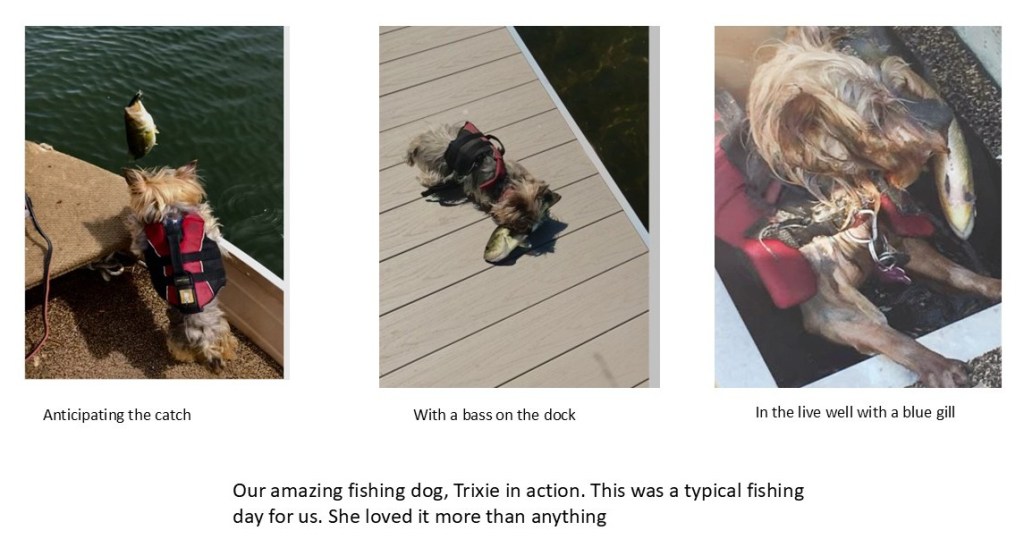
One day we were on the dock together and I was fishing. I caught a bluegill. When I unhooked it, it fell to the dock. Trixie was on it in an instant. This was the start of a fifteen-year fishing partnership. Apparently she transferred her rat-hunting instincts to fish. This partnership would be long, with many rich experiences and a source of amusement to the lake people. Sometimes an annoyance, I suspect.
Each time I’d walk down to the boat, rod in hand, she’d race down with me barking wildly and leaping at my rod. Once in the boat she sat on the bow, yipping at nearly every cast. Then she’d watch intently as I retrieved my lure. She knew when I hooked a bass. The yipping would stop. Once it was landed, she’d attack it furiously until I released it. When we were circling the lake fishing, the neighbors knew we were on the lake.
It became a bit of a joke but also a routine. People knew when we were at the cottage thanks to Trixie. One time she jumped in the lake after a fish. This prompted me to buy her a life vest. In the years to come I’d say, “Trixie, get your vest, let’s go fishing.” She’d race to the porch and come back with it, eager to be fitted. It got to the point I couldn’t leave her behind. When I tried, she’d throw herself at the door until Barb let her out.
Once she displayed intelligence that stunned me. We’d just returned to the dock. I laid my rod down while I unloaded the boat. Trixie went over, grabbed the reel handle in her mouth, and started turning the crank. She’d related turning the reel handle to catching a fish. This sounds like a tale. Her tooth marks on my reel handle are proof this is not a fish story.
Another of her antics involved bluegills. I finally brought my sixteen-foot fishing boat to the lake. It’s there to this day. This boat had an aerated live well. This was a great advantage—I could put my catch in the live well and choose to release them.
When Trixie saw the bluegills in the live well, she jumped in and grabbed one, came out and put it on the floor saying, “See what I caught?” I’d return the fish to the live well. If I didn’t close it, she’d jump back in to catch another.
One time she developed a cough that necessitated a visit to the vet. He said she’d aspirated some water. I explained her live well antics—it was from her dunking her head to catch a bluegill. He just shook his head. He’d never heard of such a thing.
We caught thousands of fish together over the years. But this is only part of Trixie’s story.
Trixie: The Hunter
Trixie loved to fish. She also loved to hunt. It became a challenge to contain her. She’d see a chipmunk or squirrel and the chase would be on. Many times she’d run off and I’d search for her. I was worried. She’d be easy pickings for the eagles or coyotes. She might also get lost in the woods. But she always made it home, sometimes an hour or so later.
When she returned, I was both angry and relieved. Of course, she was known to our lake crowd, and on a few occasions I’d get a call from a neighbor across the lake. “We have Trixie!” I had our phone number on her collar.
I never saw her catch anything, but that didn’t deter her. One time she did experience catching a red squirrel. They can be a pest. We were being overrun and they were causing problems, chewing wires and holes in our sauna room. I could no longer catch and release.
I got a pellet gun. The hunt commenced. On one occasion, Trixie and I were on the deck. A red squirrel was on a tree limb over the bird feeder. I took aim and made a clean kill. By the time it hit the ground, Trixie was on it, grabbing it by the neck and showing the thrashing technique that broke the necks of the textile mill rats.
Years later, after we sold Katie’s cottage, there was a going-away party. We’d be missed. Trixie too. She was known to all at the lake from her fishing and hunting exploits. In fact, they probably knew her name better from all the years of my calling, “Trixie, Trixie!”
She’d always make her first stop when we got to the lake at Cuff’s slider, announcing our arrival. The lake people awarded Trixie and me a lifetime pass giving us fishing access to the lake. We made good use of it together, and I still use it
to this day. Boy, was she a winner.
In her fifteenth year she experienced kidney failure. I nursed her, giving subcutaneous injections weekly. We were in Arizona at the time. My goal was to get her on the lake one more time. She made it home that spring. I took her to the lake for one last trip. But I knew the end was near. She was happy to be in the boat with me, but her normal excitement wasn’t there.
Sadly, later that summer Trixie crossed the Rainbow Bridge. She and our other girls—Rusty, Belle, Sunny, Biscuit, and Miffy—are waiting for us at the base of the bridge for the time when we’re all rejoined.
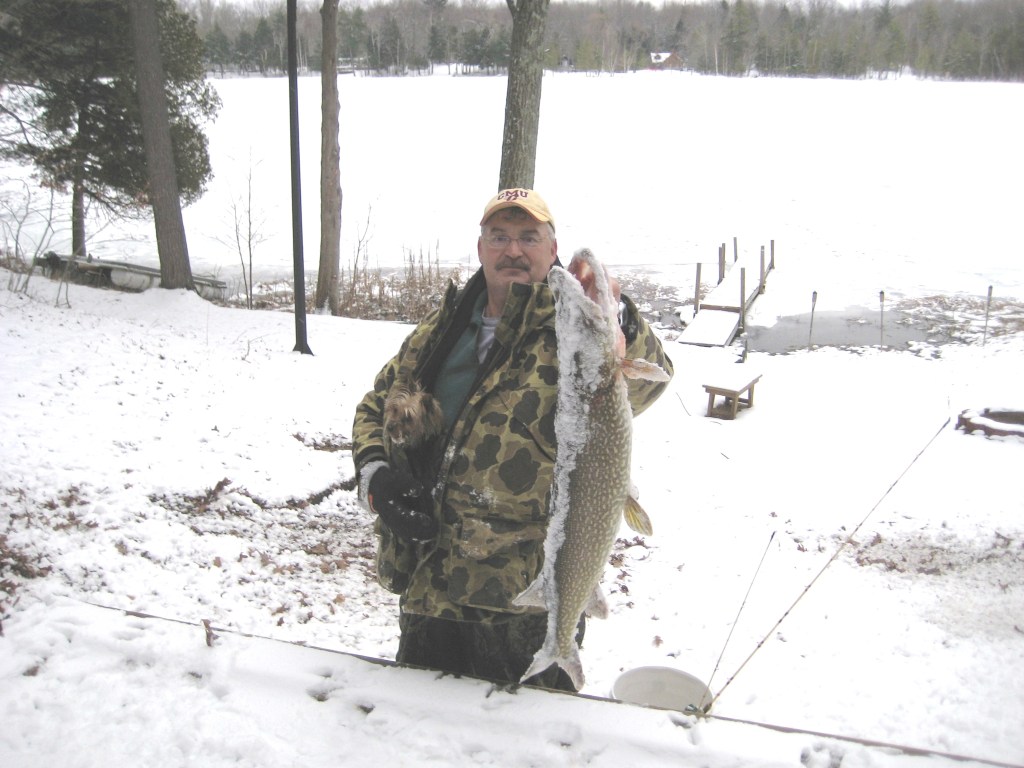
This is a “fish story” but its true. It chronicles the most amazing catch I made in my over 70 years of fishing. I have a picture to validate its not just a fantastic exaggeration. Enjoy. Note my fishing buddy Trixie peeking out of my jacket. She witnessed the entire fight. She can attest to the veracity of my story
“THE BIG GIRL”
I have been fishing for nearly seventy years. It started with me joining my dad on his little ten-foot pram, fly fishing with rubber spiders for bedding bluegills. Later I joined him on the ice as we fished the frozen waters. They say “Give a man a fish, you feed him for a day; teach a man to fish, you feed him for a lifetime.” I think it’s “Give a boy a fish and he wonders why? Teach him to fish and he has a lifelong pastime.” That’s my saying.
Over the years I’ve fished many lakes and rivers. I’ve caught tens of thousands of fish—everything from shiners to 35-pound Chinook salmon on a fly rod. For a time I fished bass tournaments. The list goes on.
Of all the fish I have caught, one stands out in my memory, and it happened on the little sixty-acre lake at our cottage. It was the catch of a lifetime—not the biggest, strongest, or rarest, but one that tested my skills and needed lady luck to chip in. I believe every avid fisherman has a similar story of that special fish. Here is mine.
The Setup
It was mid-March. The thaw was on. The ice was still safe, but it was on its way out. I was fishing at the west end of our lake. This area held the bluegills I was targeting. Often “last ice” can provide excellent fishing. I was hoping to get a nice limit of gills. I was in for a surprise.
I had brought along my most loyal fishing partner, Trixie, a six-pound Yorkshire Terrier. She was fanatical about fishing. I am certain she had transformed the rats she was bred to catch in the textile mills of England into fish. In the summer, fishing in my boat, she would aggressively attack each fish I landed. In later years, when I had upgraded my boat, she would jump in the livewell and pull out the bluegills I had caught.
Today I had her tucked into my jumpsuit, and she could peek through my open Gore-Tex fishing jacket to observe the action.
The fishing that day was slow. I was using my trusty bluegill rod carved by my dad to resemble a pump shotgun. He used to joke, “If they won’t bite, shoot ’em.” The rod was equipped with a little Schooley reel whose main purpose was to hold line, not be used to reel in fish. It was filled with fifty feet of four-pound test line, more than enough for the deepest part of our lake. The line was baited with a fluorescent pink and white glow-in-the-dark Demon Glow Jig, tipped with two spikes (blowfly larvae, maggots). This is all I fished. Of course, I was using my old reliable “sneaky” spring bobber to detect the bite.
The Strike
I was fishing in about eight feet of water when the spring started to bounce. I had a bite. I set the hook and felt a tremendous weight. “Trixie, this is a big one.” This was no bluegill. Not even a bass. The light four-pound test line would not hold this fish. I quickly loosened the washer holding the spool in place and started paying out line as the fish started a run. “Trixie, this is a whopper. I hope I can at least see what I have.” She watched intently. I joked, “Maybe it’s a big dogfish.”
The fight went on for a long time, maybe twenty minutes. It seemed longer. I knew that my only chance was to wear this fish out. I had to be patient—no rushing this one. The fish would run and I would give line. When it stopped, I would slowly pull back, gathering lost line. All the time I kept my thumb on the little red reel. This served as a drag. All this time I’m thinking, “This line has to break. It can’t take much more.” Finally the runs started to shorten, the tugging on the line less intense. The cold water and my patient fighting of the fish was wearing it out.
Finally it swam beneath the hole. I saw it! It looked like an alligator. Long, dark, prehistoric. A northern pike, but the biggest I’d ever seen. The locals had told me tales of 40+ inch pike caught in the lake, but I dismissed this as a yarn. The biggest pike I had ever caught on the lake was a 26-incher. Most of the ones I caught were “hammer handles.”
“How are we going to land this, Trixie?” She offered no ideas.
The Challenge
I faced two problems to landing this fish. First, it would never fit through my normal four-inch diameter augered hole. Second, pike have a mouth full of razor-sharp teeth. They could cut through even the strongest line. Most fishermen that target pike use 12- to 18-pound test line and steel leaders for just this reason. The four-pound test line I was using was a joke. One wrong move or turn of the fish’s head and I would be sliced like a knife through butter.
Fortunately my first problem was solved by the March thaw. I was fishing a hole previously cut by someone who had a larger auger, probably eight inches in diameter. Likely it was for a tip-up. My saving grace was the thaw had opened it even wider. I had a chance! Now I had to get the pike started up through the hole. The ice was still eight inches thick. I would have one chance. I held the line tight and moved the fish’s head back and forth beneath the hole. Finally she nosed up into the hole. I knew it was a female—we were approaching spawning season.
This was my chance. I kept the line tight, leading her head up and increasing the pressure. At the same time I reached into the hole with my bare hand and got a grip on her gills. I quickly lifted her and tossed her on the ice. “We did it, Trixie!” She jumped out of my coat and onto the ice to inspect the fish, but I quickly picked her up. The pike could have hurt her. It was at least six times bigger than she was.
I stood there for a moment in awe of the fish. It was 38 to 40 inches long and probably 18 to 20 pounds. The biggest pike I had ever caught, and on a primitive ice fishing rod equipped with four-pound test line. I examined the jig. I had hooked the fish in the corner of its mouth—the only place where it was protected from the razor-sharp teeth.
The Decision
I have caught many large fish in my lifetime. I always practice catch and release. I’m not looking for a trophy mount or even a picture. Having made the catch and winning the fight was enough for me. Let the fish go so others may enjoy catching it again or its offspring. Normally I’d just release my big fish, knowing I’d landed them. But this one… I needed proof. Not for ego. For memory. To validate in my mind this was not a dream.
She was a big girl. Thick-bodied, dark, old. She’d been in that lake for years. I wanted her back in the water where she belonged. But I had to move fast. Pike can’t stay out of water long. I had maybe ten minutes before she’d be too stressed to survive. I put her in my five-gallon bucket—she did not fit, with half her body hanging out—and I hurried over to my neighbor Mark’s cottage. Trixie, me, and Mrs. Pike.
Fortunately Mark was home, and when he saw me coming, I stopped and held up the fish. He was on his dock when I walked up. Took one look at the pike and said, “No way.” Then he saw my rod. “Four-pound test? You’re either the best fisherman on this lake or the luckiest.” Both, probably. He took a couple of quick pictures. “No time to talk. I must release the girl. I’ll fill you in later.”
The Release
The release was easier than expected. The ice had pulled away from Mark’s shoreline, and there was a small section of open water. I held her gently in the shallows, moving her forward and back to push water through her gills. For a minute, nothing. Then a twitch. Then a slow, powerful kick. She hung there for a moment, as if considering, then disappeared into the dark water. Back to her world. Back to spawn the next generation of big girls lurking in the depths. My hope is she patrolled the depths of our lake for many more years and gave birth to many other trophies.
On reflection, I think we were both lucky—me because I had the most memorable catch of my lifetime, and her because it was me that caught her. I’m certain if it had been someone else, she would never have been released. She would have been kept, shown to friends, ended up on a wall or in a freezer. This would have qualified for a state Master Angler award. Maybe even a record for pike on four-pound test. But awards and articles meant nothing to me. I had gotten the thrill of a lifetime. That was reward enough.
Some fish you keep. Some fish you release. The best ones swim away. She’s back in the lake, doing what big pike do.
The Memory
Thirty years later, I still think about her. Not because I caught her, but because I let her go. That’s the better story. The photo still exists—me holding the huge pike, exhausted and grinning, Trixie’s little Yorkie face peeking from my coat, her expression saying, “Can we go inside now?” It’s the only proof I have. But I didn’t need proof. I knew what I’d done.
The one mystery that remains is why did this massive fish bite on this tiny jig tipped with two spikes? It would be like you or me eating a pea. Maybe a small perch was biting the jig and the pike swiped at it and got my hook instead? I would never know. Trixie agrees and has no answer either.
Here is Bob’s recipe book. It contains our famous Deer Drinking Chili
Bob Quinn’s Little Bass Lake Cook Book
Page
Recipe
1
Red rice
2
Bean salad
3
Sugar beans
4
Shishkabob marinade Greek style
5
Chili
6
Beef Bar-B-Cue (squashed poop)
7
Shishkabob marinade Quinn style
8
Irish soda bread
9
Jon Hill’s spareribs
10
Foolproof spareribs
11
Posole
12
Red chili sauce
13
Fettucine Alfredo
14
Hungarian potato soup
15
Onion soup
16
Croutes for onion soup
17
Chili casserole
18
Company casserole
19
Spiced apple pancakes
20
Shrimp stir fry
21
Beef stew
22
Three bean bake (Dorothea Noon)
23
Beer bread
24
Cottage barley soup
RECIPES
Red Rice (Page 1)
Ingredients: 6 slices bacon , 1 cup diced onions , 1 cup diced red pepper , 1 cup raw rice , $1/2$ tsp. tabasco sauce , 1 tsp. paprika , 1 tsp. sugar , 1 tsp. salt , 2 large tomatoes (seeded and chopped) or 1 cup canned tomatoes (drained and chopped) , $1-1/2$ cups cold water.
Instructions: Fry bacon until crisp; drain and crumble. In bacon fat, cook onion and red pepper until soft. Add rice and stir. Mix in tabasco, paprika, sugar, salt, water, and tomatoes. Bring to a boil, cover tightly, and simmer on low for 20-25 minutes until liquid is absorbed. Let set for 10 minutes covered. Serve with crumbled bacon on top.
Bean Salad (Page 2)
Ingredients: 1 can each of wax beans, green beans, lima beans, dark red kidney beans, and garbanzo beans. 1 large red onion (thinly sliced) , 1 large bottle Italian dressing , cubes of white cheese (Swiss or Monterey Jack).
Instructions: Drain and mix all beans and onion with dressing. Marinate overnight in refrigerator. Add cheese cubes before serving.
Sugar Beans (Page 3)
Ingredients: 1 large jar (3 lbs.) Randall beans , 1 cup sugar , 6-8 slices lean bacon.
Instructions: Mix beans and sugar together. Cut bacon into squares. Cover the bottom of a bean pot with bacon squares. Pour in the bean and sugar mixture. Cover the top with the remaining bacon. Bake uncovered at $275^{\circ}$ for 4 to 5 hours until no longer watery.
Shishkabob Marinade Greek Style (Page 4)
Ingredients: 2 parts oil, 1 part fresh lemon juice , salt, garlic, oregano, and red wine to taste.
Instructions: Marinate meat cubes (pork, beef, or lamb) overnight. Squeeze lemon on meat while cooking.
Bob Quinn’s Chili (Page 5)
Ingredients: 4 lbs. beef, pork or venison (cubed) , 2 onions , 3 cloves garlic , 2 6 oz. cans tomato paste , 3 16 oz. cans stewed tomatoes , 1 10 oz. can chili puree or enchilada sauce , 2 3 oz. cans green chilies , 1 tsp. oregano , 1 tsp. cumin , 3 bay leaves , 2 tsp. salt , 2 tbs. crushed red pepper , 5 tbs. chili powder , 4 15 oz. cans kidney beans.
Instructions: Brown meat and onions. Add all ingredients except beans. Do not drain tomatoes. Simmer covered for $1-1/2$ hours. Add drained beans and simmer uncovered for 2 hours.
Squashed Poop – Beef Bar-B-Cue (Page 6)
Ingredients: 3-1/2 lbs. boneless chuck , 1 24 oz. can V-8 juice , 1 onion , 1 tbs. parsley , catsup , 2 stalks celery , 2 carrots , salt, garlic salt, red pepper, oregano, thyme, tabasco, and Worcestershire sauce.
Instructions: Cook slowly (crockpot 10-12 hours is ideal). Shred meat and simmer in sauce uncovered until desired consistency is reached.
Shishkabob Marinade Bob Quinn Style (Page 7)
Ingredients: 1 cup each of oil, fruit juice, soy sauce, and sherry wine. 1 clove garlic, 1 onion, 1 tsp. ground ginger, and garlic salt.
Instructions: Marinate meat cubes overnight. Use retained marinade for basting.
Fool-Proof Spareribs (Page 10)
Rib Preparation: Boil 4-5 lbs. of ribs in water with salt, pickling spices, and 1 onion for 1 hour. Leave in liquid until ready to broil.
Sauce Ingredients: 3 cups Open Pit, 1 cup water, 1 tbs. each of honey, brown sugar, Lawry’s salt, and Worcestershire. $1/2$ stick margarine, 3 bay leaves, and 1 tsp. each of garlic salt, onion salt, salt, pepper, dry mustard, white vinegar, and $1/2$ tsp. sage.
Instructions: Simmer sauce for one hour. Baste ribs frequently over low coals to brown.
Posole (Page 11)
Ingredients: 1-1/2 lbs. boneless pork (diced), 2 14-1/2 oz. cans golden hominy, 1/4 cup chopped onion, 1 clove garlic, 1/2 tsp. cumin, 1/2 tsp. oregano, 1-1/4 tsp. salt.
Instructions: Brown pork, drain fat, and add 2 cups water and 1 tsp. salt. Simmer covered for 1-1/2 to 2 hours. Add undrained hominy, onion, and spices. Simmer 15-20 minutes, then uncover until consistency is correct.
Red Chili Sauce (Page 12)
Ingredients: 1/4 cup oil, 1/4 cup flour, 1/2 cup chili powder, 1 16 oz. can tomato sauce, 1 tsp. garlic salt, 2 cups cold water, 1 tsp. salt.
Instructions: Heat oil, stir in flour and chili powder until moistened. Gradually stir in water until lumps are gone. Add tomato sauce and salts; simmer 12-20 minutes.
Fettucine Alfredo (Page 13)
Ingredients: 1 lb. fettuccine, 1/4 cup melted butter, 3/4 cup parmesan, 1 cup heavy cream, black pepper.
Instructions: Drain cooked noodles and pour into a heated bowl. Toss with butter, cream, parmesan, and pepper. Serve immediately.
Hungarian Potato Soup (Page 14)
Ingredients: 1/2 cup onion, 2 tbs. butter, 4 potatoes (diced), 1-1/2 tsp. salt, 1/4 cup flour, 1-1/2 tsp. paprika, 1 cup sour cream, 2-1/2 cups milk.
Instructions: Cook onion in butter. Add potatoes, salt, and 1 cup water; cook until tender. Blend flour, paprika, and sour cream; stir into potatoes. Add milk and heat to almost boiling.
Soup Instructions: Cook onions in butter/oil for 20-30 minutes until brown. Stir in flour, then beef broth; simmer 30-40 minutes.
Croutes: Brush French bread slices with olive oil and bake at 325° for 24 minutes (turning once). Rub with garlic and dust with parmesan.
Chili Casserole (Page 17)
Ingredients: 2 lbs. ground beef, 1/4 cup brown sugar, 1/4 cup vinegar, spices (chili powder, cumin, salt, red pepper), 4 cups water, 3 onions, 1 green pepper, 2 cloves garlic, 1 can kidney beans, 2 cups uncooked macaroni.
Instructions: Brown beef with sugar, vinegar, spices, and 2 cups water. Simmer with vegetables and beans for 1-1/2 hours. Mix with cooked macaroni and bake 45 minutes at 375°.
Company Casserole (Page 18)
Ingredients: 1-1/2 lbs. ground beef, 3/4 cup raw rice, 1 can tomatoes, 3 tbs. oil, 2 onions, 1 green pepper, salt, chili powder, basil, marjoram, pepper.
Instructions: Saute vegetables and brown beef. Mix all ingredients and bake covered at 320° for 45 minutes; uncover and bake 15 minutes more.
Instructions: Pour 4 tbs. melted butter over batter; bake at 350° for 50 minutes. Pour 3 more tbs. over bread and bake 20 more minutes.
Cottage Barley Soup (Page 24)
Ingredients: 3 large cans broth, 1 can mushroom soup, 1 cup each carrot/onion/celery, 1-1/2 cups mushrooms, 1-1/2 cups beef or chicken, 1 cup pearled barley.
Instructions: Simmer meat in broth for 1 hour; add remaining ingredients and cook 30-45 minutes.
This is an unpublished work provided for review purposes only. No part of this manuscript may be reproduced, distributed, or transmitted in any form or by any means without prior written permission of the
Entry 9: The Ice Fishing Legacy and Mapping the Water
Fishing was part of my DNA. We lived in a small town on the Black River. It had a dam and millpond. There were dozens of lakes in a 12-mile radius of us. They provided abundant opportunity to fish.
My earliest introduction was to ice fishing. It’s a sport that makes fishing accessible to everyone. No boat or special equipment required. Just a “spud” or auger, a small rod with light line, a bucket, and an ice strainer, and you were good to go. Of course, warm clothing is a must to comfortably survive the winter chill. Often, we fished at single degree temps.
I started out on the ice at 6 years old going with my father. Of course, if the bite was slow, I would inevitably poke around and get wet boots. I would cry “I want to go home” less than an hour after we settled on the ice. My Dad and my typical exchange were Him: “I’m never taking you again.” My response was: “I never want to go again!” Until the next time I saw him readying to go, and begged “Take me!” Ultimately, Mom would intercede and off again I would go, my dad hoping I would last a couple of hours.
The primary tool for stationary fishing on the lake was the tip-up. This simple device consists of a spool of line suspended under the ice and a flag on a spring that sits low to the surface. To set it, you first auger a hole, then bait the hook with a minnow and drop it to the desired depth. The tip-up line is positioned so that when a fish takes the bait, the tension pulls the spool, releasing the spring and snapping the flag upright—a brilliant burst of red against the white ice. It’s an exercise in patience until that flag flies, signaling a race across the ice to grab the line.
Dad and I preferred to target panfish, much easier to get a mess of gills for a meal. Over the years I continued the sport and became a good fisherman. My knowledge, technique, and tackle evolved. Sneaky spring bobbers replaced cork bobbers. Laser augers replaced spuds. Winter gear evolved to keep you warm in the harshest conditions. Gortex, Thinsulate, insulated “Micky Mouse” flight boots, and rag wool mittens combined with insulated jumpsuit coveralls were the clothing of choice. I was not one to sit at a hole and wait for fish. I was a seek-and-find fisherman. Equipped with a creel to hold fish, I would cut dozens of holes until I found “biters.”
The pan fish we caught in the area I grew up in were decent and plentiful but typically in the 7-inch range. “Good Eaters” we called them. Filleted they were good table fare. But the 10-inch Bluegill was more of a myth than a reality in our lake ecosystem. I brought my 40 years of experience to our new lake and was eager to explore and confirm it was a good fishing lake. I knew I could find fish if they were to be found.
THE Holy Bluegills
My luck changed one Sunday in Mid-January. We were planning on attending Mass at 11am. I had time to fish before Church.
I got settled in and then it happened. Around 10 am the big ones started biting—9-9 ½ in gills with an occasional 10 inches. They were on the feed.
I was filling my bucket and I was the only person on the lake. It was the best ice fishing day I had ever experienced.
Time slipped by and the fish kept biting. I could not—and would not—interrupt this.
About 10:45 I looked to the East where our Cottage was and I saw a small figure stomping across the ice. It was Barb. I was in trouble. Church and Mass would be missed. (This was before cell phones, thankfully, so she could not call me.)
When she finally got close, I blurted out “I’m having the best ice fishing day of my life” I showed her my catch, and though she was NOT happy with me, she knew my passion and reluctantly I was absolved. But it was a story that was repeated regularly at our frequent Lake social gatherings.
In the years that followed I took thousands of fish through the ice fishing alone and with my friends. But like your first girlfriend, that day was a memory that stands the test of time. I had many other great days on the lake. Some were probably better, but this day was etched in my memory. I froze 6 of the largest gills and that summer I had a taxidermist friend mount them. It is lasting proof to this day of the Holy, Immaculate Ice fishing experience. I had finally found the fishing lake of my dreams. It had an abundance of good healthy Fish. It had few fishermen and was secluded. I could find fish even if they were not biting in the usual spots. It was as personal and private a lake you could ask for. It was a fisherman’s Nirvana.
“The stories within these pages are my own. They are told to the best of my memory, though I recognize that memory is an imperfect lens. I have made every effort to ensure the integrity of the events recorded here; however, in some instances names have been changed and certain details altered to respect the privacy of others. Dialogue has been created from memory. While certain sequences have been compressed for the sake of the narrative. This is not a historical record, but a personal one.”
Entry 4: The Scent and the Small Things (Fall 1994)
The place was clean. It was also empty. We needed signs of life. We needed to change the air.
The first job was small. Barb brought the photographs. We hung them on the cheap paneled walls. The art was wildlife pictures. We added knickknacks.
I brought the gear. The bamboo rod and creel hung above the window. It faced the lake. The cottage felt more ours. The walls watched the progress.
Then, the smell. The structure had an odor. It was not rot. It was not damp. It was cottage. A distinct, dry scent of old wood, pine needles, and stale air. It was a good smell. It was the smell of arriving.
We did not try to kill it. We honored it. The scent was a signature. It was the proof of the place. We opened the windows. The new blinds managed the light. The room held the scent. The scent made it home.
These pictures are from Year 1 when we first found the Cottage- The fireplace is shown post remodeling.
This is an unpublished work provided for review purposes only. No part of this manuscript may be reproduced, distributed, or transmitted in any form or by any means without prior written permission of the
“The stories within these pages are my own. They are told to the best of my memory, though I recognize that memory is an imperfect lens. I have made every effort to ensure the integrity of the events recorded here; however, in some instances names have been changed and certain details altered to respect the privacy of others. Dialogue has been created from memory. While certain sequences have been compressed for the sake of the narrative. This is not a historical record, but a personal one.”
JOURNAL ENTRY 26: CANDY MOUNTAIN
It was a mid-July weekend. I decided to take on a small project Saturday morning. We had a beautiful old maple tree across from the porch. It deserved to be profiled. I decided circling it with a rock border was a good start.
I took a yardstick and circled the tree, using it like the hand of a clock. This gave me a nice arc. Using my sod shovel, I traced the arc. Step one was done. I had gathered softball- and cantaloupe-sized rocks from the gravel pit. These would do the job. I placed the rocks around the line I had traced. Then I shoveled topsoil into the ring up to the top of the stones. I repeated this process three times and had a nice elevated flower bed with a rock border.
I would spread some bark on top and plant some shade-tolerant plants—ferns, lily of the valley, maybe some ground cover. I had access to all these and would transplant them in the fall, the best time to divide perennials. I also thought about hostas. They’re shade-tolerant, but they would never survive. Locals called them “deer lettuce.” Plant them today, eaten to the ground by morning.
Project completed. Barb, Katie, and I decided to drive to Manistee, about twenty-five miles north of us. It’s on U.S. 31, which runs north along Lake Michigan through several small towns—Traverse City, Charlevoix—ending in Petoskey. This was a route we would occasionally take to Grandpa Rocky’s place. It was scenic but also forty-five minutes longer than our normal route.
Manistee has a rich history. It sits on the shores of Lake Michigan, with the Manistee River flowing into Manistee Lake and spilling into the big lake. In the mid-1800s, it was a bustling logging town. Ideal location: logs were cut, floated down the river into the lake, staged, and taken to one of the many sawmills in town. It was a lucrative business. In the mid-1800s, Manistee boasted more millionaires per capita than any city in the U.S. Today, many of the Victorian estates of the lumber barons are still standing.
As the lumber business faded, salt was discovered under the city. Manistee became known as “Salt City U.S.A.” Morton Salt, Martin Marietta, and Packaging Corporation of America are the big companies still operating there. More millionaires were made.
The town also had a foundry, Manistee Iron Works, now closed. With all this industry, labor was needed. Manistee was cut in two by the highway. On the east side were the factories and row houses for common labor. On the west side, huge Victorian estates were built, along with upscale homes along the shore of Lake Michigan. The highway was the line of demarcation.
Today tourism is a primary industry in Manistee. They have a beautiful one-way street running through town with shops, restaurants, and several antique stores. It also has the Ramsdell Theater, built in 1903—a reminder of the town’s heyday and the cultural scene of the affluent.
This was our destination. There was a high-end shoe store, Snyders, that Barb liked. When I joked she was approaching Imelda Marcos territory with her shoe collection, she countered with how many fishing rods I owned. She had a point. I encouraged her to buy the shoes she wanted.
With the new shoes safely in the car, we went to our favorite antique shop. Each shop has booths where local collectors stage their wares in exchange for a commission paid to the shop on each sale. At this particular shop, we’d found treasures before.
Barb would typically look for Lu-Ray dishes—pastel-colored dishware from the 1950s that fit our cottage’s theme perfectly. We could always count on finding a few new pieces.
We had been searching for a 1950s-style dining table—colorful Formica top, chrome legs and trim. They came in a wide range of colors. Matching chairs had vinyl seats and backs. Both our families had them when we were growing up.
We had been looking for some time but never found one that was “just right” or in our price range. On this day, we got lucky. The store operator said she knew of a couple that had one for sale. She called them. They still had it and were eager to sell. We got the address.
It was one of the row houses. When we arrived, we were met by the husband. He had just been laid off. The wife was at work. Three kids watched us from inside the house.
“It’s in the basement. Follow me,” he said.
When we got to the basement, wet clothes were hung on a line from the exposed beams, and piles of wet clothes sat on tables or in laundry baskets.
“Our dryer broke,” he explained.
The table was just what we were looking for—gray and white Formica with pink speckles. There were four matching chairs.
“How much are you asking?”
“One seventy-five,” he said. “I need to buy a dryer and I need to sell this quickly.”
Barb and I looked closer. It wasn’t exactly what we wanted because we wanted six chairs, but it was close. We said, “We’ll think about it,” and left.
When we got a block away, I said, “Let’s buy it.” Barb agreed, and we went back.
We knocked on the door. The husband answered.
“We’ve decided to buy the table and chairs on one condition,” I said. “The price is two twenty-five.” Fifty dollars more than he was asking.
We said at one seventy-five he was giving the set away. We wanted to be fair and figured the money meant more to him than us.
The deal was struck. He was delighted.
We said we wished it had two more chairs. He said, “Well, the lady next door has them.” He called her and she said she’d be happy to sell the pair for fifty dollars.
Deal done. We now had our table and chairs for the grand total of two seventy-five. This was less than what we’d seen for similar sets.
As we were leaving, he stepped outside and saw Katie in the car. He asked, “Have you been to Candy Mountain?” He saw our blank look and added, “It’s the best candy place. You have to go.”
Finding it was a bit of a challenge. The directions took us into a residential area of row houses. We actually drove by it twice. Candy Mountain was a two-story building sided with green asphalt shingles. There was a small sign in the window and one nailed to the outside wall. We were a bit apprehensive but decided to go in.
When we opened the door, it was like Alice through the looking glass. We stopped and stared. The interior was old, with twelve-foot ceilings. Disney character figurines and posters lined the walls. There was an old Felix the Cat clock.
Katie just stared at the collection of Disney characters. Disney World was her most favorite place. She was taking all this in.
But what truly fascinated us—Barb and me particularly—was that all the candy was retro from the 1950s and ’60s. The candy of our childhood. Nothing after the late ’60s was stocked.
The store had shelves along two walls with a set of shelves dividing the room like a boulevard. There was a supply of small bags along the way. And the candy: Mary Janes, Squirrel Nut Chews, wax lips, Nickel Nips, Clark bars, Zero bars, Pixie Stix, jawbreakers, bubble gum cigars, Sugar Daddies, Slo Pokes, little packages of cinnamon hearts, Chum Gum, Blow Pops, Charleston Chews, root beer barrels, Necco wafers, and candy cigarettes. If you could name it, they had it.
I was a candy connoisseur. My Grampa Walt had a grocery store in the little town where I grew up—Walt’s Grocery. I had free rein to take what I wanted. This is the reason I have a mouth full of fillings. I would often accompany my grandpa to the wholesale house where he bought his supplies. I would tell him which candies were the kids’ favorites—mine too.
Katie filled her bag carefully, asking about each candy. “What’s this one, Dad?” She’d never heard of most of them—they were from before her time, candies Barb and I had grown up with. We were sharing our past with her, one Mary Jane at a time.
In addition to the penny candy, they also made chocolate specialties: milk and dark chocolate seafoam, turtles—those caramel and pecan treats coated with chocolate—all types of fudge, and you could special order chocolate Easter bunnies. What a place. We must have been there an hour, filling little sacks with candy.
When we went to pay for our bounty, I noticed behind the counter on the wall a pigeonhole cabinet like you would see in an old hotel where room keys and messages were held. I noticed several of the pigeonholes had envelopes.
I asked, “What are those?”
The owner told me each envelope had a neighborhood kid’s name on it. The parents would put money in the envelope and that would be the child’s candy allowance. They could come into the store after school or on weekends when they were out playing and get their candy fix. No parent needed. It was all prepaid.
Man, how I love small Midwest towns.
When we went to pay, the bigger items had prices, but the penny candy in the bags was put on a scale and we were charged by weight. We had truly “scaled” Candy Mountain.
In the years that followed, we often visited the mountain. Several times we special ordered Easter bunnies. When Barb asked the price, the owner said, “Between five and fifty dollars.” They were custom made. They would be the featured prize of the Easter egg hunt at the cottage.
Easter morning, all would be hidden, but the intense effort was to find the chocolate bunny. When it was found, the ears were always the first to go. Katie or Barb could not resist. Then we shared. We shared this special place with many of Katie’s friends who would join her at the cottage. I thought about ordering an “ears down” bunny just for a joke, but figured that would be mean.
We enthusiastically shared our find with lake friends who had never heard of it.
But the day wasn’t finished. We had yet to have dinner. Just down the street on the corner, we saw a place called the Painted Lady Saloon. It was a bar that served food and originally served the workers from the nearby factories. We went in. It was old, cozy, and had a nice feel to it.
We later learned it was the oldest bar in Manistee, over 120 years old. It served good food, specializing in broasted chicken and homemade soups. My favorite is the chicken pot pie soup. Fridays they have the traditional fish fry. Lots of Catholics in this little town.
It was once a working man’s bar. Drinks were reasonable. The draft beer was poured liberally. One favorite drinking pastime involved Pabst Blue Ribbon beer. Under the bottle cap of the longnecks was a particular card from the deck of fifty-two. To settle who paid for the round, the cap was turned over revealing the card. Low card paid.
There was a picture on the mirror of two old-timers drinking, with one saying, “Larry, if we don’t stop drinking, in ten years we’ll look like those two drunks.” His buddy Bill replied, “Larry, you’re looking in the mirror, you dumbass.”
Our trip to Manistee was an eventful Saturday in July. We would go back many times over the years and still visit the Painted Lady. Sadly, Candy Mountain closed in the early 2000s. We miss it still.
What we did not know at that time was that in the years to come, the little town of Manistee would become an even more special place to the Dentzman family.
The following is an entry from my memoir. I will be placing various ones on this site for your reading pleasure. I would love comments as I am trying to make it better
JOURNAL ENTRY 11: NEIGHBORS AND THE WINTER SOCIAL SCENE (WINTER 1994-1995)
This was more than a place. It was a social ecosystem. Connected. A large family. We all had similar objectives: A retreat from the hectic day-to-day. A place for solitude and reflection. A helping community. A place to gather and celebrate together.
It was a diverse group: retirees, white-collar, and blue-collar workers. Some were year-round residents braving icy Michigan winters. Others were snowbirds retreating to warmer climes in winter. Then there were us, the weekenders looking to leave daily life behind. Of the twenty-four cottages, a handful were year-rounders.
The social scene was interesting. Half were friends from downstate; several were related. Most all had a history together. It was a family—a large, diverse, and, like many families, a bit dysfunctional.
We were the first new people on the lake in over a decade: outsiders, newbies. How would we be accepted? We were fortunate; our next-door neighbors, Cuff and Bev, were in the middle of the scene. They were good friends with everyone. More importantly, they took us under their wings and eased us into the group.
Typically, each weekend would have an informal gathering: cocktails, catching up on the week, or simply being together. On a typical Saturday, if you were working on a project, someone would stop by mid-afternoon with an extra beer, check progress, suggest a beer break, and offer insights or help.
One hard and fast rule when working on projects together: tradesmen measured, cut, and installed. Office workers carried, shoveled, and took on work that did not require any degree of skill. It was, though humbling, a good rule.
After several informal get-togethers with Cuff and Bev at their “wooden tent,” and their close friends next door, Bob and Casey Norin, we were invited to the Christmas party. One reliable constant of lake parties: more than enough food, more than enough alcohol, and an abundance of stories. Many were repeated often over the years, where you felt like a participant or observer in the story.
At this first party, we established ourselves. We were entering the family. It felt natural. Once accepted, we received knowledge, support, and resources that helped ingrain us into the ecosystem. Our decision was reinforced.
At that first Christmas party, we learned personal histories—how everyone came here. We also learned these people enjoyed life and liquor. We learned the term ARI (Alcohol-Related Incidents)—there were many.
This was a safe haven. Many had teenage kids. At the lake, they could drink their beer, act out, and have fun. The rule was it needed to be contained to lake property. No booze cruises. The result was many kids that partied here became the next generation of stewards of our safe haven.
Coming back to ARIs, two of the most memorable were the Coke. (Her real name was Mary. Not sure of the origin of the nickname.) sledding accident and Norin’s Arctic plunge.
The Coke incident was a result of a sledding run gone bad. After a long night of drinking, a group exhibited liquor-influenced judgment and decided sledding down a wooded hill onto the lake at one of the cottages was a good idea. You can guess the result. On one of the first runs, she hit a tree and broke a collar bone. A trip to the hospital followed.
The Norin incident was a bit different. Bob Norin, a former Naval Aviator and Captain, was of Swedish descent. The Swedes, as a rule, loved Aquavit as a winter warmer. Bob would typically bring a bottle, remove the cork, and toss it away. The gauntlet had been laid—the bottle was to be emptied. Aquavit is horrible stuff—it tastes like a combination of jet fuel and nail polish remover, but it gets the job done.
On one of those fateful nights, Bob, fully fueled, stripped down to nothing but a Viking helm with horns and wandered down to the lake. Mind you, this was early winter; we were iced over, but not enough to support a person. Undeterred, Bob walked out on the dock, stepped on the ice, and promptly fell through. Fortunately, he was quickly rescued, with the only injury being his pride.
Hard to imagine this was the behavior of a 40-year career naval officer, who was once the Naval Attaché to the King of Sweden, Inspector General, former temporary Captain on the aircraft carrier Independence, and a fighter pilot. But here he was—just Bob, affectionately called Skipper, living out his older years at the lake.
While his resume sounds made up, I witnessed several things which validated these stories. Air Force jets from a nearby post would periodically do a flyby and dip their wings in front of Bob’s cottage. On a different occasion, I saw a photo of Henry Kissinger at Bob’s, signed “To my good friend Bob.” One day while I was there, he received a letter forwarded from the Department of the Navy; it was from the “Swedish Cigar Club,” a prestigious club of politicians, military officers, and Swedish royalty. Bob was one of two non-Swedish nationals admitted, the other Lord Mountbatten, who was assassinated in 1979. Once again, a Norin story was confirmed. Though the letter was in Swedish, Bob’s name was listed as a member.
Many more Norin stories would follow over the years. The third memorable ARI involved our neighbors George and Ginny. They lived four cottages down from us, about two hundred yards away. George and Ginny were married twice—to each other. The first time, Ginny divorced George because he was such an ogre when he had back problems. After they were fixed, they got back together.
This particular incident tested that reunion. George was at Quinn’s one night, deep into the Scotch. Late into the night. As he staggered home, he apparently got tired. He laid down on a hillside about a hundred yards from his house and slept there all night. When he was not home in the morning, Ginny packed the car and drove back to Holland. Not sure how George ever got back.










 The Necessity of a Place- 30 years at the Water’s Edge