I came across the article below the other day and thought I would share it with you. While it discusses the characteristics of financial success I believe it pertains to many other areas in our lives as well and how you personally define success.
Read it and at the end I will explain how it relates to biking across America.
I apologize in advance if this is starting to sound like a self-help or motivational blog. I’m simply sharing what’s working and what has worked for me. Also I need to put in these “filler posts” until the ride starts. Then I will be scrambling to share my daily adventures with you. So I hope you enjoy them and extract a small measure of value.
Why Aren’t More Highly Intelligent People Rich? A Nobel Prize-Winning Economist Says Another Factor Matters a Lot More
Nobel Prize-winning economist James Heckman likes to ask people how great a role innate intelligence plays in financial success. Like how much the difference between my income and yours, for example, is based on our relative IQs.
Most people say about 25 percent. Some go as high as 50 percent. (For a long time, I would gave guessed even more.)
But Heckman’s research reveals something else entirely. Innate intelligence plays, at best, a 1 to 2 percent role in a child’s future success.
Instead, financial success is correlated with conscientiousness: Self-discipline, perseverance, and diligence.
That comes as no surprise to people familiar with research on married couples: People with relatively prudent and reliable partners tend to perform better at work, earning more promotions, making more money, and feeling more satisfied with their jobs.
“Partner conscientiousness” (for men and women) predict future job satisfaction, income, and likelihood of promotion.
According to the researchers, “conscientious” partners perform more household tasks, exhibit more pragmatic behaviors that their spouses are likely to emulate, and promote a more satisfying home life, all of which enables their spouse to focus more on work.
As one researcher said, “These results demonstrate that the dispositional characteristics of the person one marries influence important aspects of one’s professional life.”
In non-research-speak, a partner sets a good example, and makes it possible for you to be a better you.
Granted, luck also plays a major role in success. As the researchers write, “The maximum success never coincides with the maximum talent, and vice-versa. Our simulation clearly shows that such a factor is just pure luck.”
But you can’t control luck. And you can only partly control IQ. While you can certainly become more educated, fluid intelligence — the ability to think logically and solve problems independent of acquired knowledge — is somewhat trainable but tends to be largely fixed.
But what you can control is how conscientuous you are. How diligent you are. How persistent you are.
How hard you work.
Everyone defines success differently, as well they should. But if you happen to define success by traditional measures, like professional achievement, or fortune, or fame, hard work is the great equalizer.
You may not be smarter than everyone else. You may not be as talented. You may not have the same great connections, the same great environment, or the same great education.
You may have none of those things.
But you can substitute effort for intelligence — because, over time, effort results in skill and experience. You can always be more persistent than others. You can always be more disciplined.
That you can control.
And that, science says, will have the biggest impact on your success.
My Take on the Article
Ok. I strongly agree with this article. Personally, it was how I conducted myself in sports, academics, and business.
I knew I was not the most gifted athlete, brightest student or smartest business person. I definitely did not have a pedigree or connections. I was a lower middle class kid from rural Michigan.
But early on I learned that what I lacked in these areas I could make up for with effort. I talked about shooting jump shots for hours and being a gym rat. This got me All-State honors and into a great college. When I ran track in high school I chose the 440 probably one of the most physically challenging events. But I knew that if I ran my hardest for the 1/4 mile most others would break. It got me 4th in the conference.
At K-College I was in classes with valedictorian, Salutatorian, and National Merit Scholars from big high schools. Coming from little Bangor High I was out classed, but I studied 4-5 hrs a night my Freshman year to get C’s and B’s until I learned how to be a student. I was determined not to be a Freshman washout. In Grad School I was basically an A student.
Early in my work career I definitely was not top shelf. I set my eyes on a goal. I found people who were successful and modeled myself after them. And yes I had my share of luck. But I rose to be the Treasurer of a NASDAQ 100 Company. And hard work, and persistence were a big part of it.
As the article says, conscientiousness, self-discipline, persistence and , I would add, self-awareness are things you can control or learn. This latter, self-awareness, is important because it helps you reflect candidly on what is working, short comings that need improvement and how you are perceived.
So what’s my point? Virtually everything I accomplished in my life was a result of hard work and focus. I don’t claim to be a superstar in any area of my life but I was better than OK for the most part in anything I attempted as a result of my work ethic.
I knew to be a success I had to “outwork” the other guy/gal and I relished that challenge. Maybe it’s my competitive spirit.
I’ve also had a great partner in my wife, Barb, who has been supportive of all my crazy endeavors, which have been numerous. I could not have done half as much without her by my side.
Perhaps insight to my wife happened when I was working in the North Bay of California. Barb came out to visit and we had dinner with a co-worker. He remarked to Barb, “I never imagined someone so nice being married to Bob”.
Yep I hit the lottery with my wife of 40 years, as well as with my amazing daughter. This was not a result of hard work but “luck” as the article mentions. Also says something about me too, eh? Maybe I need to revisit “self awareness”!
Persistence is also key. Tony Robbins of “Personal Power” fame tells us: “The past is not a predictor of the future. Because you have failed previously does not mean you won’t succeed the next time”. He talks about a baby learning to walk. The kid falls dozens of times but we all eventually walk right? (assuming no physical handicap). Parents never say “ my kid keeps falling he/she will never walk.” The little kid is persistent.
We have heard-the famous quote from Thomas Edison “I’ve not failed, I discovered 10,000 ways that won’t work!”
Hard work, persistence, I think we are on to something.
So now as I approach my my Trans-America Ride I’m confident I can do it. I logged 5000 miles last year and will have ridden 1000 by the end of February and 1500 by April 1.
I’ve been persistent and conscientious, and I plan to have out worked the typical 68 year old and probably my fellow riders. This should set me up for success as I define it!
So as I continue to prepare for my journey I’ll leave you with these thoughts:
There are very few things in life you can control. But you can control the effort you put forth, your persistence, and your diligence to be successful in whatever area you choose.
Embrace the challenge, the hard work, the sweat, getting outside your comfort zone, etc . It will make you a better person. And, frankly, you will come to enjoy making the effort when you think about the others that are not.
Let’s face it, life is a process. If you aren’t moving forward, you are not just standing still, you are going backwards.
So, will this advice make you financially successful like this article suggests? Well there’s one way to find out right? Plus at the very least, it will make you a better version of yourself and frankly help your self-esteem.
When I’m out riding 50-60 miles pounding it I feel pretty darn proud of myself. What others think is really irrelevant to me.
Until next time, Smooth roads and may the wind be at your back. (Unless you want a challenge, then ride into the wind)
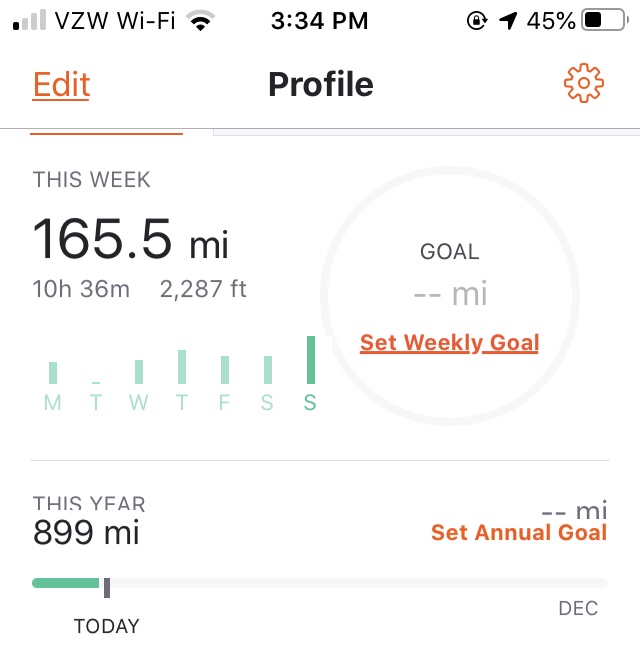
This week’s Stats. Sat was a challenge. Alan Parsons concert Fri night late night (asleep by 3 am). But I got a ride in despite not wanting to

 Growing Up All Over Again