
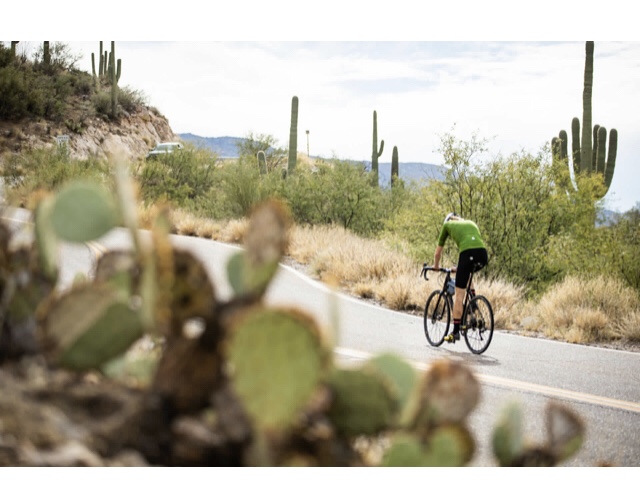
So the ride coordinator is going to host a session on changing flats before we leave San Diego. Gee any of us who ride in Az or other states that have cactus, goat heads and other prickly friends are well acquainted with punctured tubes. In fact, when I rode in NoCal there was road debris that always resulted in the dreaded “thump,thump, thump.”
Now they say the pro riders can change a tire in 10 secs. Sure their SAG vehicle just grabs another wheel and with a little quick release magic the tire is switched.
For us unlucky (the majority) amateurs it’s either change the tube or speed dial the wife, husband, or significant other.
Now changing a tire should not be a big deal right? Simply remove the tire, check for nails, thorns etc, put on a new tube (from your saddle pack) and inflate with a CO2 cartridge or your trusty Mini hand pump.
Of course you will have to have arms like Popeye to get pressure up to 80lbs using the hand pump! And don’t screw up using your CO2 cartridge.
Oh, a tip on hand pumps. Get one that does not screw on to the valve . You can easily end up unscrewing the valve stem and then you are, in good old English, “Hosed”.(Done it) Find one that clips to your Presta or Schrader valve.
Anyway, my experience is, it’s not as easy as it looks on TV. In fact my Local Bike Shop owner says he makes his monthly payment on a new Ford Raptor from his tire repair revenue alone.
So what’s the big deal? Well first, getting the tire off can be a challenge depending on the wheel. On my Rol’s it was a snap. On the Roval’s it was a bit tougher and on my new Mavic‘s it’s a bit of a pain to say the least. Now tire levers help a lot and worked ok with my other wheels but the Mavic’s required a little trick.
See with the advent of tubless tires many wheels, like my Mavic’s, now have a deeper rim and lip. So If not done properly, you can easily snap the tire levers ( yep, I have). Or worse yet, when the new tire is on and the tube is pinched, have it explode when inflating (yep done that too)
The trick on these type of tires ( I learned this after taking in my tire to the LBS owner and helping him with his truck payment) is making sure the tire is in the center channel of the wheel. If you leave the tire in the rim channel the circumference is too big to fit). So when I defied Rob to change the tire using my levers, he simply pushed the tire out of the rim channel and into the center, tire off and changed in 3 min. It works I know.
So an other alternative is to ride puncture resistant tires. Gator Skins and Armadillos are the most popular of these. But guess what , there is something called “rolling resistance”. Both these tires are pretty puncture resistant. But you sacrifice speed and I think they ride rough.
An example, when I got my new Specialized it has Armadillos on it. The first few times I rode with my normal group I was 1/2 mile behind them in 1 hr. I thought “gee this new bike is pretty slow or I really have lost speed”! A week later I changed to Continental 4000’s and I was now back ahead by a nice margin. Then I bought the new Continental 5000’s and was faster yet.
The following is a link to a chart which shows the rolling resistance for many popular tires for those bike geeks reading this As an example the Conti 4000’s have a rolling resistance on 12 watts at 120psi. The Gators have a RR of 19.5 watts. Of course, I have no flipping idea what this really means. But the Gators are slower (if you exclude the down time to change your tire😆)
https://www.bicyclerollingresistance.com/road-bike-reviews
But with the Conti 4000’s the flats started piling up. A couple of times I had multiple flats on a 30 mile ride. So I went to my standby Continental 4 seasons. Flats went away and speed only decreased marginally.
So the net, net on this is if you are riding locally and want speed choose the tires with the best rolling resistance. If you are doing long rides and want to minimize flats go with the Armadillos or gator skins. But they are a stiff tire and not a cinch to change.
Personally, I am going with the 4 seasons for my xcountry ride.
WAXING
Ok now you probably have been waiting anxiously for the waxing. Well while it’s true the pro riders remove body hair, but it’s not because of the Lycra speedos or for wind drag. Actually, it’s for treating road rash when they crash. It’s much easier to cleanse the wounds if there is no hair in them. Makes sense to me.
But the waxing I’m referring to is for your chain. Hot waxing your chain can provide a very clean and nice lube. In fact the times I’ve tried it I have had smoother and faster rides. A well lubed chain does make a difference. The problem is the hot wax needs to be done every 300 miles and that means taking off the chain and putting it in a crock pot of hot wax. Not worth it for me but you may find it worthwhile.
Presently, I’m using Finish Line ceramic chain wax and another liquid wax. It’s pretty dry here in AZ and the wax lubricants work well.
You have all heard the comments about ”dry heat” it’s true. Makes riding pretty swell too. No sweat soaked jerseys😉.I suspect once I do the big trip I with use traditional lubes. But for now it’s awful nice to be able to grab your chain and not have greasy hands or the dreaded chain mark on your calves.
So there you have it. My personal take on flat repairs, tire rolling resistance and chain waxing. I am certain many of you can elaborate or may have different experiences. Heck I’m not a technical guy but I do learn from my experience (generally). And I’m always willing to listen for new and better ways to improve. So feel free to share.
PS. Yesterday I repaired 5 tubes that had cactus pin hole punctures. I figured Rob already has enough help with his truck payment😉
So until the next post, May you have smooth roads and the wind at your back.
Sent from my iPhoneBob Dentzman 616-886-8192

 Growing Up All Over Again